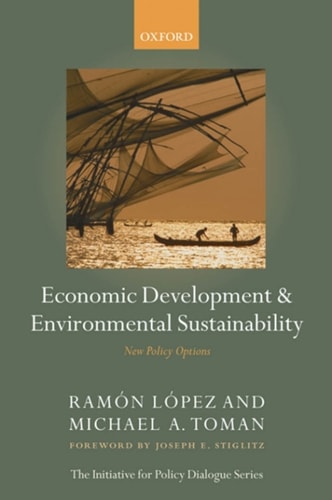
Economic Development and Environmental Sustainability: New Policy Options
0
0
As an Amazon Associate and affiliate partner, Menrva Books earns from qualifying purchases. Learn more
Author Description
Economic growth as we know it today cannot persist indefinitely if it entails continuous degradation of natural resources and the environment. While in a few countries around the world it appears that environmental degradation has been the result of rapid economic growth, in the vast majority of the developing countries the environment has been equally spoiled despite slow or even negative economic growth. This book provides new insights on the common roots of economic stagnation, poverty and environmental degradation which, unfortunately, generally reside in misguided government policies and priorities. By doing this, the volume seeks to provide a broader policy option framework than those found in conventional policy analyses, mainly dominated by the "Washington Consensus". It shows that a major omission of the conventional view is that governments tend to allocate government expenditures in a biased way favouring subsidies to the economic elites to the detriment of investments in public goods, including human capital, R&D, as well as the development of institutions (environmental and otherwise), which are vital for long run growth, poverty reduction and environmental sustainability.
Menrva's Summary
THE THESIS
This book investigates the systemic relationship between economic stagnation, poverty, and environmental degradation, arguing that misguided government policy is the primary driver of these issues. Ramon E. Lopez, a scholar in development economics, utilizes a comparative analysis of developing nations to challenge the prevailing "Washington Consensus." He posits that government expenditure biases—specifically the prioritization of elite subsidies over public goods like human capital and institutional development—are the fundamental barriers to sustainable growth.
THE SCOPE MAP
What You Will Find
- Analysis of government expenditure patterns and their impact on environmental health
- A critique of the "Washington Consensus" policy framework
- Theoretical models linking public goods investment to long-term sustainability
- Case studies examining the intersection of poverty and resource depletion
Scope Limits
- Does not provide specific localized policy implementation guides for individual nations
- Does not focus on private sector environmental initiatives independent of government policy
THE AUTHORITY PERSPECTIVE
Experts recognize this work as a critical contribution to development economics, particularly for its focus on the structural misallocation of public funds. Readers frequently note the academic density of the prose, which is best suited for policy analysts, economists, and graduate-level students of development.
Page Count:
504
Publication Date:
2006-09-14
Publisher:
Oxford University Press
ISBN-10:
0191538221
ISBN-13:
9780191538223
Economics
Agriculture
Public Policy
Sustainability
Trades & Technology
Community Tags
Similar Books