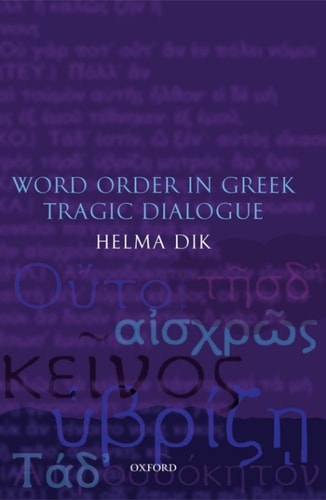
Word Order in Greek Tragic Dialogue
0
0
As an Amazon Associate and affiliate partner, Menrva Books earns from qualifying purchases. Learn more
Author Description
Helma Dik approaches word order in Greek tragic dialogue from the perspective of language rather than metre. The tragic poets engaged in mimesis of natural dialogue; therefore the analysis of the linguistic characteristics of the dialogue precedes exploration of the metrical dimension, on the assumption that poets would not be overly constrained by the iambic trimeter, which, after all, was the most natural speaking verse according to Aristotle. Dik analyses the word order of tragic dialogue in pragmatic terms, arguing that, in sentences, words functioning as Topic (the 'starting point' of an utterance) or Focus (the most salient piece of information) will come early, and that other less important words will follow. Similarly, the position of adjectives within noun phrases is analysed as a function of their relative salience rather than in terms of their semantics. This approach aims to account for word order in sentences generally, but it also allows for a new interpretation of familiar phenomena in Greek, such as 'postponed interrogatives'. The book concludes with a commentary on the word order in four passages of Sophocles' Electra.
Menrva's Summary
THE THESIS
This work investigates the linguistic principles governing word order in Ancient Greek tragic dialogue, challenging the traditional view that metrical constraints primarily dictate syntax. Helma Dik, a specialist in classical linguistics, argues that tragic poets prioritized the mimesis of natural speech patterns over rigid metrical requirements. By applying a pragmatic framework, the author posits that word placement is driven by the functional roles of Topic and Focus rather than purely poetic or semantic considerations.
THE SCOPE MAP
What You Will Find
- A pragmatic analysis of sentence structure focusing on Topic and Focus positioning.
- A methodology for evaluating adjective placement within noun phrases based on salience.
- A detailed commentary on word order patterns found in four specific passages from Sophocles' Electra.
Scope Limits
- The study does not provide a comprehensive analysis of all extant Greek tragedy.
- The text does not focus on the historical evolution of the Greek language beyond the context of tragic dialogue.
THE AUTHORITY PERSPECTIVE
Scholars in the field of classical philology recognize this text as a significant contribution to the understanding of Greek syntax and the mechanics of tragic verse. Readers frequently note the academic density of the prose, which is intended for those with a strong background in linguistics and classical Greek grammar.
Page Count:
300
Publication Date:
2007-01-01
Publisher:
Oxford University Press
ISBN-10:
0191535427
ISBN-13:
9780191535420
Philosophy
Existentialism
Ancient Greek
Greek language
Greek drama
History & Surveys
Literary Criticism
Dialogue
Linguistics
Philology
World Languages
Community Tags
Other Editions(3)


Similar Books