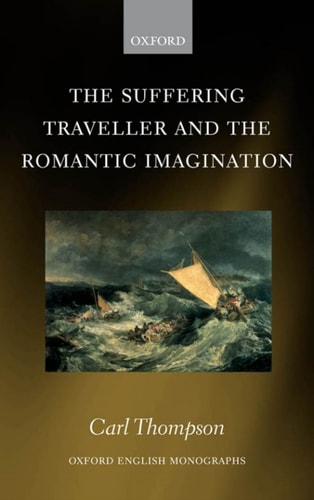
The Suffering Traveller and the Romantic Imagination
0
0
As an Amazon Associate and affiliate partner, Menrva Books earns from qualifying purchases. Learn more
Author Description
Carl Thompson explores the romance that can attach to the notion of suffering in travel, and the importance of the persona of 'suffering traveller' in the Romantic self-fashionings of figures such as Wordsworth and Byron. Situating such self-fashionings in the context of the upsurge of tourism in the late eighteenth century, he shows how the Romantics sought to differentiate themselves from mere tourists by following alternative models, and alternative travel 'scripts', in both their travelling and their travel writing. In a rejection of the more conventional roles of picturesque tourist and Grand Tourist, Romantic travellers often preferred to style themselves as heroic explorers, oppressed and endangered mariners, even shipwreck victims. The Suffering Traveller and the Romantic Imagination accordingly returns to the sub-genres of Romantic-era travel writing - the shipwreck narrative, the exploration narrative, the captivity narrative, and the like - that first kindled the Romantic fascination with these figures, to consider the travel scripts seemingly enabled by this source material. Paying particular attention to the narratives of shipwreck and maritime suffering that were a hugely popular part of Romantic-era print culture, and to the equally popular narrative of exploration, the book considers firstly the examples, traditions, and conventions that trained Romantic travellers to think that misadventure as much as adventure could be a route to visionary experience and literary authority. It then explores the political resonance that the figure of the suffering traveller could possess in this Revolutionary era, before treating Wordsworth and Byron as especially influential examples of the 'misadventurous' tendency in Romanticism. In so doing, The Suffering Traveller and the Romantic Imagination offers interesting new perspectives not only on British Romanticism and on travel writing of the Romantic era, but also on many attitudes, practices, and typologies still
Menrva's Summary
THE THESIS
This work investigates how the persona of the 'suffering traveller' functioned as a critical tool for self-fashioning among Romantic-era writers. Carl Thompson, an expert in Romantic literature, examines the intersection of travel writing, print culture, and the desire for literary authority during the late eighteenth and early nineteenth centuries. He argues that figures like Wordsworth and Byron utilized specific 'travel scripts'—such as the shipwrecked mariner or the heroic explorer—to distinguish themselves from the burgeoning class of conventional tourists.
THE SCOPE MAP
What You Will Find
- Analysis of Romantic-era sub-genres including shipwreck, exploration, and captivity narratives.
- Examination of the political resonance of suffering in the context of the Revolutionary era.
- Case studies on the travel practices and writings of William Wordsworth and Lord Byron.
Scope Limits
- The study focuses primarily on British Romanticism and does not provide an exhaustive survey of global travel literature.
- The analysis is restricted to the late eighteenth and early nineteenth centuries.
THE AUTHORITY PERSPECTIVE
Scholars recognize this text as a significant contribution to the study of Romantic-era travel writing and the construction of the authorial self. Readers frequently note the academic density of the prose and the depth of the historical research provided.
Page Count:
288
Publication Date:
2007-01-01
Publisher:
Clarendon Press
ISBN-10:
0191531928
ISBN-13:
9780191531927
In literature
British literature
Cultural History
Romanticism
Criticism history
English & College Success
Travel Writing
English
Literary Criticism
Community Tags
Other Editions(2)
Similar Books


Reader Comments
Share Your Thoughts
No comments yet. Be the first to share your thoughts!