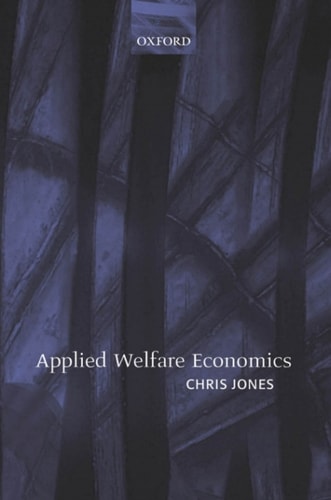
Applied Welfare Economics
0
0
As an Amazon Associate and affiliate partner, Menrva Books earns from qualifying purchases. Learn more
Author Description
Applied Welfare Economics uses important results in the welfare economics literature to extend a conventional Harberger cost-benefit analysis. After reviewing the properties of different welfare measures a conventional welfare equation is used to evaluate marginal policy changes in a general equilibrium economy with tax distortions. The analysis is extended to accommodate trade and income taxes, time, internationally traded goods, and non-tax distortions, including externalities, non-competitive behaviour, public goods and price quantity controls. The welfare analysis is developed in stages, and where possible is explained using diagrams, to make it more adaptable to the different institutional arrangements encountered in applied work. With this in mind, computable welfare expressions are solved using demand and supply elasticities for each good. The lump-sum transfers used in a conventional analysis to separate welfare effects are carefully examined to identify the role of the marginal social cost of public funds (MCF) in policy evaluation. The main contribution in the book is to separate income effects for marginal policy changes in the shadow value of government revenue, which converts efficiency effects into dollar changes in private surplus. It is a scaling coefficient that makes income effects irrelevant in single (aggregated) consumer economies, and conveniently isolates distributional effects in heterogeneous consumer economies. The decomposition is used to test for Pareto improvements, and to examine the separate but related roles of the shadow value of government revenue and the MCF in applied work.
Menrva's Summary
THE THESIS
This book investigates how to extend conventional Harberger cost-benefit analysis to evaluate marginal policy changes within a general equilibrium economy characterized by tax distortions. Chris Jones utilizes established welfare economics literature to construct a framework that accounts for complex institutional arrangements. By developing welfare analysis in stages, the author provides a methodology for assessing policy impacts through demand and supply elasticities.
THE SCOPE MAP
What You Will Find
- General equilibrium models incorporating tax distortions
- Analysis of trade taxes, income taxes, and externalities
- Methodologies for evaluating public goods and price quantity controls
- Computable welfare expressions using demand and supply elasticities
- Decomposition of income effects and the shadow value of government revenue
Scope Limits
- The text focuses primarily on marginal policy changes rather than large-scale structural shifts
- It assumes a technical understanding of economic theory and mathematical modeling
THE AUTHORITY PERSPECTIVE
Experts identify this text as a rigorous resource for practitioners seeking to apply theoretical welfare economics to real-world policy evaluation. Readers frequently note the technical density of the prose, which is intended for those with a strong background in economic analysis.
Page Count:
332
Publication Date:
2005-01-01
Publisher:
OUP Oxford
ISBN-10:
0191536016
ISBN-13:
9780191536014
Economics
Microeconomics
Public Policy
Community Tags
Similar Books