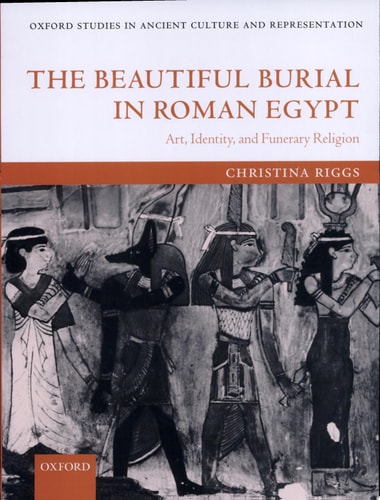
The Beautiful Burial in Roman Egypt: Art, Identity, and Funerary Religion
0
0
As an Amazon Associate and affiliate partner, Menrva Books earns from qualifying purchases. Learn more
Author Description
This important new study looks at the intersection of Greek and Egyptian art forms in the funerary sphere of Roman Egypt. A discussion of artistic change, cultural identity, and religious belief foregrounds the detailed analysis of more than 150 objects and tombs, many of which are presented here for the first time. In addition to the information it provides about individual works of art, supported by catalogue entries, the study explores fundamental questions such as how artists combine the iconographies and representational forms of different visual traditions, and why two distinct visual traditions were employed in Roman Egypt.
Menrva's Summary
THE THESIS
This study investigates how the convergence of Greek and Egyptian artistic traditions shaped the funerary practices and cultural identity of Roman Egypt. Christina Riggs, an expert in Egyptian archaeology and art history, utilizes a comprehensive analysis of over 150 funerary objects and tombs to examine the synthesis of visual languages. The work argues that these artistic choices were not merely aesthetic but reflected complex negotiations of identity and religious belief within a multicultural colonial context.
THE SCOPE MAP
What You Will Find
- Analysis of funerary art, including mummy portraits and tomb iconography
- A detailed catalogue of over 150 specific objects and burial sites
- Theoretical framework for interpreting cross-cultural artistic hybridization
- Examination of the socio-political context of Roman-era Egypt
Scope Limits
- The study focuses primarily on funerary contexts and does not provide an exhaustive survey of domestic or public art from the period
- The analysis is restricted to the specific visual traditions of Roman Egypt and does not extend to broader Mediterranean funerary customs
THE AUTHORITY PERSPECTIVE
Scholars and archaeologists frequently cite this work as a foundational text for understanding the visual culture of Roman Egypt. Readers often note the academic density of the prose, which provides a rigorous examination of material culture for specialists in the field.
Page Count:
358
Publication Date:
2006-01-01
Publisher:
Oxford University Press, USA
ISBN-10:
0191534870
ISBN-13:
9780191534874
History
Ancient History
Art History
Roman Empire
Ancient Egypt
Egypt - History
Archaeology
Community Tags
Similar Books