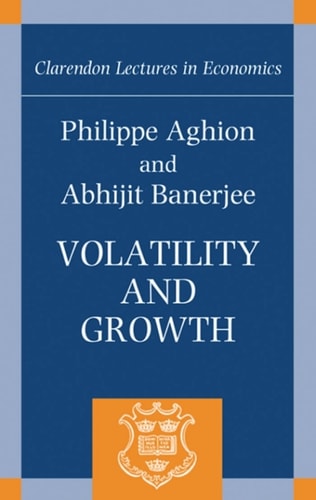
Volatility and Growth
0
0
As an Amazon Associate and affiliate partner, Menrva Books earns from qualifying purchases. Learn more
Author Description
It has long been recognized that productivity growth and the business cycle are closely interrelated. Yet, until recently, the two phenomena have been investigated separately in the economics literature. This book provides the first consistent attempt to analyze the effects of macroeconomic volatility on productivity growth, and also the reverse causality from growth to business cycles. The authors show that by looking at the economy through the lens of private entrepreneurs, who invest under credit constraints, one can go some way towards explaining persistent macroeconomic volatility and the effects of volatility on growth. Beginning with an analysis of the effects of volatility on growth, the authors argue that the lower the level of financial development in a country the more detrimental the effect of volatility on growth. This prediction is confirmed by cross-country panel regressions. The data also suggests that a fixed exchange rate regime or more countercyclical budgetary policies are growth-enhancing in countries with a lower level of financial development. The former reduce aggregate volatility whereas the latter reduce the negative effects of volatility on long-term productivity-enhancing investment by firms. The book concludes with an investigation into how the interplay between credit constraints and pecuniary externalities is sufficient to generate persistent business cycles and to explain the occurrence of currency crises.
Menrva's Summary
THE THESIS
This book investigates the complex, bidirectional relationship between macroeconomic volatility and productivity growth, specifically focusing on how credit constraints influence these dynamics. Authors Abhijit Vinayak Banerjee and Philippe Aghion, both distinguished economists, utilize a theoretical framework centered on the behavior of private entrepreneurs to explain why volatility persists and how it impacts long-term economic development. They argue that the degree of financial development within a nation dictates the severity of these effects, providing a rigorous analytical model for understanding business cycles and currency crises.
THE SCOPE MAP
What You Will Find
- Theoretical models linking credit constraints to investment behavior
- Cross-country panel regression analysis of financial development levels
- Examination of exchange rate regimes and countercyclical budgetary policies
- Analysis of pecuniary externalities in generating persistent business cycles
Scope Limits
- The text does not provide a comprehensive history of global financial crises
- It does not offer general policy advice for developed economies with high financial maturity
THE AUTHORITY PERSPECTIVE
Experts recognize this work as a foundational text for understanding the intersection of growth theory and macroeconomic volatility. Readers frequently note the academic density of the prose, which is intended for professional economists and graduate-level students.
Page Count:
160
Publication Date:
2005-01-01
Publisher:
OUP Oxford
ISBN-10:
0191530239
ISBN-13:
9780191530234
Economics
Macroeconomics
Principles of Macroeconomics
Academic
Finance
Community Tags
Similar Books