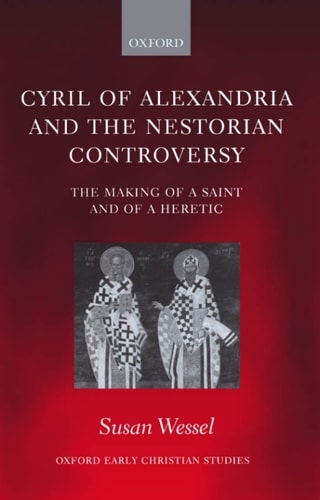
Cyril of Alexandria and the Nestorian Controversy: The Making of a Saint and of a Heretic
0
0
As an Amazon Associate and affiliate partner, Menrva Books earns from qualifying purchases. Learn more
Author Description
What were the historical and cultural processes by which Cyril of Alexandria was elevated to canonical status while his opponent, Nestorius, bishop of Constantinople, was made into a heretic? In contrast to previous scholarship, Susan Wessel concludes that Cyril's success in being elevated to orthodox status was not simply a political accomplishment based on political alliances he had fashioned as opportunity arose. Nor was it a dogmatic victory, based on the clarity and orthodoxy of Cyril's doctrinal claims. Instead, it was his strategy in identifying himself with the orthodoxy of the former bishop of Alexandria, Athanasius, in his victory over Arianism, in borrowing Athanasius' interpretive methods, and in skilfully using the tropes and figures of the second sophistic that made Cyril a saint in the Greek and Coptic Orthodox Churches.
Menrva's Summary
THE THESIS
This work investigates the historical and cultural mechanisms that facilitated the canonization of Cyril of Alexandria as a saint while simultaneously casting his rival, Nestorius, as a heretic. Susan Wessel, a scholar of early Christian history, challenges the traditional view that Cyril’s victory was purely a result of political maneuvering or superior doctrinal clarity. Instead, she argues that Cyril successfully leveraged the legacy of Athanasius and employed specific rhetorical strategies rooted in the second sophistic to secure his orthodox standing.
THE SCOPE MAP
What You Will Find
- Analysis of the theological conflict between the sees of Alexandria and Constantinople.
- Examination of the rhetorical techniques and tropes derived from the second sophistic.
- Comparative study of Athanasian interpretive methods and their application by Cyril.
Scope Limits
- The text does not provide a comprehensive biography of Nestorius outside of his conflict with Cyril.
- The analysis focuses primarily on the construction of orthodoxy rather than a general history of the Council of Ephesus.
THE AUTHORITY PERSPECTIVE
Scholars frequently cite this work for its nuanced approach to the intersection of rhetoric and ecclesiastical power in the fifth century. It is regarded as a significant contribution to the study of how early Christian identity was constructed through textual and cultural performance.
Page Count:
308
Publication Date:
2004-01-01
Publisher:
Oxford University Press
ISBN-10:
0191533270
ISBN-13:
9780191533273
Biography
History
Religion
Church History
Christian Theology
Patristics
Community Tags
Similar Books