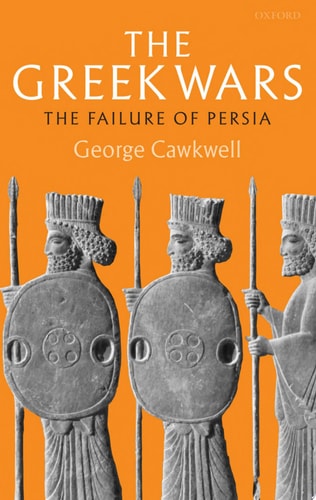
The Greek Wars: The Failure of Persia
0
0
As an Amazon Associate and affiliate partner, Menrva Books earns from qualifying purchases. Learn more
Author Description
The Greek Wars treats of the whole course of Persian relations with the Greeks from the coming of Cyrus in the 540s down to Alexander the Great's defeat of Darius III in 331 BC. Cawkwell discusses from a Persian perspective major questions such as why Xerxes' invasion of Greece failed, and how important a part the Great King played in Greek affairs in the fourth century. Cawkwell's views are at many points original: in particular, his explanation of how and why the Persian invasion of Greece failed challenges the prevailing orthodoxy, as does his view of the importance of Persia in Greek affairs for the two decades after the King's Peace. Persia, he concludes, was destroyed by Macedonian military might but moral decline had no part in it; the Macedonians who had subjected Greece were too good an army, but their victory was not easy.
Menrva's Summary
THE THESIS
This work investigates the strategic and political factors behind the failure of the Persian Empire to subjugate Greece and the subsequent collapse of Persian power under Alexander the Great. George Cawkwell, a noted scholar of ancient history, utilizes primary source analysis to re-evaluate the Persian perspective on the Greco-Persian conflicts. He challenges established historical narratives regarding the decline of the Achaemenid Empire, arguing that military defeat by Macedonian forces was the primary cause of collapse rather than internal moral decay.
THE SCOPE MAP
What You Will Find
- A comprehensive timeline of Persian-Greek relations from the 540s BC to 331 BC.
- An analysis of the logistical and strategic failures of the Xerxes invasion.
- A detailed examination of Persian influence on Greek internal affairs during the fourth century.
Scope Limits
- The text does not provide a general history of the Persian Empire outside of its direct interactions with the Greek city-states.
- It does not focus on the cultural or social history of the Persian people, remaining strictly within the realm of political and military history.
THE AUTHORITY PERSPECTIVE
Historians and scholars of the classical period frequently cite this work for its unconventional interpretation of Persian strategic decision-making. Readers often note that the prose is dense and assumes a high level of prior knowledge regarding the political landscape of the ancient Mediterranean.
Page Count:
330
Publication Date:
2006-01-01
Publisher:
Oxford University Press, U.S.A.
ISBN-10:
0191541249
ISBN-13:
9780191541247
History
Greece
Ancient Greece
Persian Empire
Ancient History
Military History
Community Tags
Similar Books