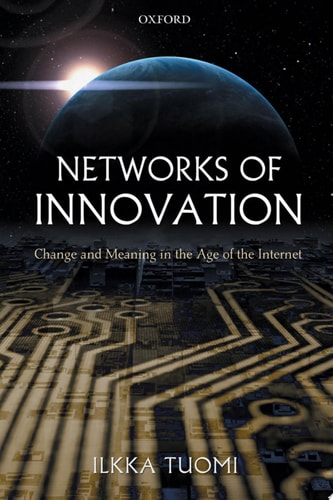
Networks of Innovation: Change and Meaning in the Age of the Internet
0
0
As an Amazon Associate and affiliate partner, Menrva Books earns from qualifying purchases. Learn more
Author Description
Innovations are adopted when users integrate them in meaningful ways into existing social practices. Histories of major technological innovations show that often the creative initiative of users and user communities becomes the determining factor in the evolution of particular innovations. The evolutionary routes of the telephone, the Internet, the World Wide Web, email, and the Linux operating system all took their developers by surprise. Articulation of these technologies as meaningful products and systems was made possible by innovative users and unintended resources. Iterative and interactive models have replaced the traditional linear model of innovation during the last decade. Yet, heroic innovators and entrepreneurs, unambiguous functionality of products, and a focus on the up-stream aspects of innovation still underlie much discussion on innovation, intellectual property rights, technology policy, and product development. Coherent conceptual, theoretical and practical conclusions from research on knowledge creation, theory of learning, history of technology, and the social basis of innovative change have rarely been made. This book argues that innovation is about creating meaning; that it is inherently social; and is grounded in existing social practices. To understand the social basis of innovation and technology development we have to move beyond the traditional product-centric view on innovations. Integrating concepts from several disciplinary perspectives and detailed analyses of the evolution of Internet-related innovations, including packet-switched computer networks, World Wide Web, and the Linux open source operating system, the book develops foundations for a new theoretical and practical understanding of innovation. For example, it shows that innovative development can occur in two qualitatively different ways, one based on evolving specialization and the other based on recombination of existing socially produced resources.
Menrva's Summary
THE THESIS
This book investigates the core question of how technological innovation is driven by social meaning and user integration rather than purely linear development models. Ilkka Tuomi, a researcher in knowledge management and innovation, challenges the traditional product-centric view of technology. By synthesizing research from learning theory, the history of technology, and social science, he argues that innovation is an inherently social process grounded in existing practices and the creative recombination of resources.
THE SCOPE MAP
What You Will Find
- Analysis of the evolution of packet-switched networks, the World Wide Web, and Linux.
- A theoretical framework distinguishing between specialization-based and recombination-based innovation.
- Discussion on the shift from linear to iterative, interactive models of technology development.
Scope Limits
- The text does not provide a comprehensive history of all internet technologies, focusing instead on specific case studies to illustrate theoretical points.
- It does not offer a prescriptive manual for corporate product management, focusing instead on conceptual foundations.
THE AUTHORITY PERSPECTIVE
Experts recognize this work as a significant contribution to the social study of technology and innovation management. Readers frequently note the academic density of the prose, which requires a strong background in sociology or technology studies to fully synthesize the author's arguments.
Page Count:
264
Publication Date:
2006-01-01
Publisher:
Oxford University Press, USA
ISBN-10:
0191555177
ISBN-13:
9780191555176
Technology
Innovation
Internet History
Business strategy
Sociology
eCommerce
Community Tags
Similar Books