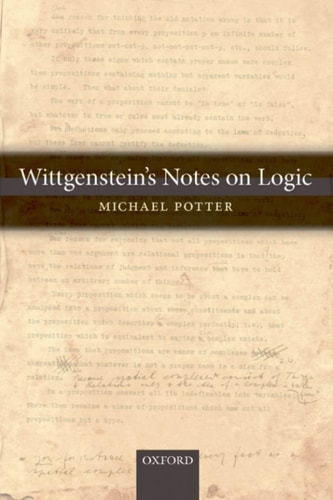
Wittgenstein's Notes on Logic
0
0
As an Amazon Associate and affiliate partner, Menrva Books earns from qualifying purchases. Learn more
Author Description
Wittgenstein's philosophical career began in 1911 when he went to Cambridge to work with Russell. He compiled the Notes on Logic two years later as a kind of summary of the work he had done so far. Russell thought that they were 'as good as anything that has ever been done in logic', but he had Wittgenstein himself to explain them to him. Without the benefit of Wittgenstein's explanations, most later scholars have preferred to treat the Notes solely as an interpretative aid in understanding the Tractatus (which draws on them for material), rather than as a philosophical work in their own right. Michael Potter unequivocally demonstrates the philosophical and historical importance of the Notes for the first time. By teasing out the meaning of key passages, he shows how many of the most important insights in the Tractatus they contain. He discusses in detail how Wittgenstein arrived at these insights by thinking through ideas he obtained from Russell and Frege. And he uses a challenging blend of biography and philosophy to illuminate the methods Wittgenstein used in his work. The book features the complete text of the Notes in a critical edition, with a detailed discussion of the circumstances in which they were compiled, leading to a new understanding of how they should be read.
Menrva's Summary
THE THESIS
This book investigates the philosophical and historical significance of Ludwig Wittgenstein's 'Notes on Logic' to establish them as an independent work rather than merely a precursor to the 'Tractatus'. Michael D. Potter, an expert in the history of analytic philosophy, utilizes a combination of biographical context and rigorous textual analysis to re-evaluate these early writings. By tracing the influence of Bertrand Russell and Gottlob Frege on Wittgenstein's development, Potter argues that the 'Notes' contain foundational insights that have been historically overlooked or misunderstood by scholars.
THE SCOPE MAP
What You Will Find
- A complete critical edition of Wittgenstein's 'Notes on Logic'.
- An analysis of the intellectual exchange between Wittgenstein, Russell, and Frege.
- A methodological framework for interpreting early 20th-century logical notation and philosophical intent.
Scope Limits
- The text does not provide a comprehensive biography of Wittgenstein's entire life.
- It does not attempt to resolve all debates surrounding the later Wittgensteinian philosophy.
THE AUTHORITY PERSPECTIVE
Scholars recognize this work as a significant contribution to the study of early analytic philosophy, particularly for its success in elevating the status of the 'Notes' within the Wittgensteinian canon. Readers frequently note the academic density of the prose, which requires a foundational understanding of formal logic and the history of the Vienna Circle to fully appreciate.
Page Count:
336
Publication Date:
2009-01-01
Publisher:
OUP Oxford
ISBN-10:
019155068X
ISBN-13:
9780191550683
Philosophy
Biography
History & Surveys
Philosophy history
Academic
Logic
Community Tags
Similar Books