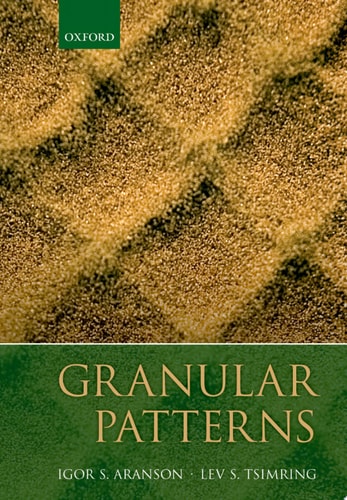
Granular Patterns
0
0
As an Amazon Associate and affiliate partner, Menrva Books earns from qualifying purchases. Learn more
Author Description
This book is a systematic introduction to a new and exciting field of patterns in granular matter. Granular materials are collections of discrete macroscopic solid grains with a typical size large enough that thermal fluctuations are negligible. Despite this seeming simplicity, properties of granular materials are different from conventional solids, liquids and gases due to the dissipative and highly nonlinear nature of forces among grains. The last decade has seen an explosion of interest to nonequilibrium phenomena in granular matter among physicists, both on the experimental and theoretical side. Among these phenomena, one of the most interesting is the ability of granular matter upon mechanical excitation to form highly ordered patterns such as ripples, avalanches, or bands of segregated materials. This book presents a comprehensive review of experiments and novel theoretical concepts needed to understand the mechanisms of pattern formation in granular materials. This book is written for experienced physicists interested in this new rapidly developing field, as well as young researchers and graduate students entering this field. We hope that both experimentalists and theorists already working in the field will find it useful.
Menrva's Summary
THE THESIS
How do discrete, macroscopic solid grains organize into complex, ordered patterns under mechanical excitation? Authors Igor Aranson and Lev Tsimring provide a systematic introduction to the physics of granular matter, focusing on the dissipative and nonlinear forces that distinguish these materials from traditional solids, liquids, and gases. The text synthesizes experimental observations with theoretical frameworks to explain phenomena such as ripples, avalanches, and segregation bands.
THE SCOPE MAP
What You Will Find
- Analysis of nonequilibrium phenomena in granular systems
- Theoretical models for pattern formation mechanisms
- Review of experimental data regarding macroscopic grain interactions
- Mathematical descriptions of dissipative forces
Scope Limits
- Does not cover thermal fluctuation-dominated systems
- Excludes basic introductory physics concepts for non-specialists
THE AUTHORITY PERSPECTIVE
Experts recognize this work as a foundational text for researchers and graduate students entering the field of granular physics. Readers frequently note the technical density of the prose, which assumes a high level of prior knowledge in physics and mathematics.
Page Count:
358
Publication Date:
2009-01-01
Publisher:
OUP Oxford
ISBN-10:
0191560006
ISBN-13:
9780191560002
Statistical mechanics
Mathematical Physics
Earth Sciences
Fluid dynamics
Physics