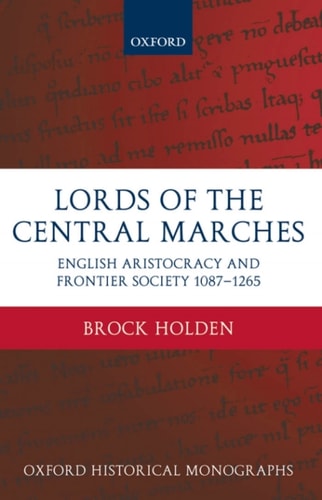
Lords of the Central Marches: English Aristocracy and Frontier Society, 1087-1265
0
0
As an Amazon Associate and affiliate partner, Menrva Books earns from qualifying purchases. Learn more
Author Description
In the Middle Ages, the March between England and Wales was a contested, militarised frontier zone, a 'land of war'. With English kings distracted by affairs in France, English frontier lords were left on their own to organize and run lordships in the manner that was best suited to this often violent borderland. The centrepiece of the frontier society that developed was the feudal honour and its court, and in the March it survived as a functioning entity much longer than in England. However, in the twelfth century, as the growing power of the English crown threatened Marcher honours, their lords asserted their independence from the king's courts, and the March became a land where 'the king's writ did not run'. At the same time, the increased military capability of their Welsh adversaries put the Marcher lordships under enormous military and financial strain. Brock Holden describes how this unusual frontier society developed in reaction to both the challenge of the native Welsh and the power of the English kings. Through a multi-faceted examination-political, economic, social, legal, and military-of the lordships of the Central March of Wales, it examines how the 'feudal matrix' of Marcher power developed over the course of the eleventh to thirteenth centuries.
Menrva's Summary
THE THESIS
This work investigates how the unique socio-political structure of the Central March of Wales emerged as a response to the dual pressures of Welsh military resistance and the encroaching authority of the English crown. Brock Holden, a scholar of medieval history, utilizes a multi-faceted analytical framework to examine the evolution of feudal honours between 1087 and 1265. By synthesizing political, economic, social, legal, and military data, the author argues that the Marcher lordships maintained a distinct, autonomous feudal system long after such structures had faded in the English heartland.
THE SCOPE MAP
What You Will Find
- A detailed analysis of the feudal honour and its court as the primary unit of frontier governance.
- An examination of the legal autonomy of Marcher lords and the concept of the king's writ not running in the region.
- A study of the military and financial strain imposed by Welsh adversaries on English frontier lords.
Scope Limits
- The study is geographically confined to the Central March of Wales.
- The chronological scope is strictly limited to the period between 1087 and 1265.
THE AUTHORITY PERSPECTIVE
Scholars recognize this monograph as a specialized contribution to the study of Anglo-Welsh frontier dynamics and medieval administrative history. Readers frequently note the academic density of the prose, which is intended for an audience familiar with medieval feudal structures and institutional history.
Page Count:
304
Publication Date:
2008-01-01
Publisher:
Oxford University Press
ISBN-10:
0191563439
ISBN-13:
9780191563430
History
Social History
British History
Political History
Great Britain
European History
Military History
Community Tags
Similar Books