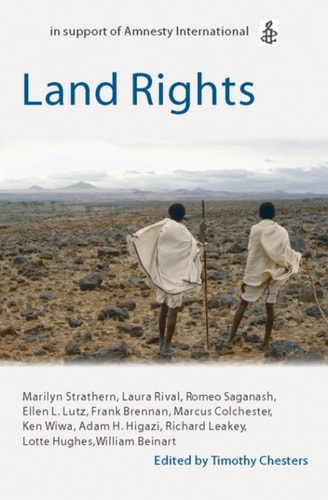
Land Rights: Oxford Amnesty Lectures
0
0
As an Amazon Associate and affiliate partner, Menrva Books earns from qualifying purchases. Learn more
Author Description
Indigenous peoples and governments, industrialists and ecologists all use - or have at some stage to confront - the language of land rights. That language raises as many questions as it answers. Rights of the land or rights to the land? Rights of the individual or rights of the community? Even accepting that such rights exist, how to arbitrate between competing claims to land? Spanning as they do a wide range of intellectual territory, and their spheres of interest or activity ranging geographically from the Niger Delta to Papua New Guinea, from Quebec to the Eastern Cape, the contributors to this volume move across a range of different, and at times contradictory, approaches to land rights. Marilyn Strathern explores the divergent anthropologies of land, specifically regarding the equation of land and property. Cree lawyer and spokesman Romeo Saganash and Frank Brennan, an Australian lawyer and priest, explore the legal framework for land claims. The UN's International Decade of the Rights of Indigenous People recently ended in the failure of negotiating govemnents to accommodate, within international law, a 'collective' right to land. It is only by acknowledging this collective right to self-determination, both argue, that governments can come to terms with their indigenous populations and their own colonial past. Against the pleas of Brennan and Saganash, the Kenyan Richard Leakey, whose own history and politics is indissociable from that past, questions the whole notion of 'indigeneity'. The campaigner Ken Wiwa speaks too of the difficulties of redressing historical injusticeis, especially in a region - the Niger Delta - where the indigenous Ogoni have no written record of their losses. Finally William Beinart, a historian and advisor to the South African government, outlines some of the practical difficulties of land reform in that country.
Menrva's Summary
THE THESIS
This volume investigates the complex intersection of legal, ethical, and historical frameworks governing land rights and the competing claims of indigenous populations versus state and industrial interests. Edited by Timothy Chesters, the text compiles lectures from the Oxford Amnesty series to examine how the concept of land rights is defined, contested, and implemented across diverse global regions. The contributors, including legal scholars, anthropologists, and activists, analyze the failure of international law to adequately address collective rights and the ongoing challenges of reconciling colonial histories with contemporary land reform.
THE SCOPE MAP
What You Will Find
- Comparative analysis of land rights in the Niger Delta, Papua New Guinea, Quebec, and the Eastern Cape.
- Legal and anthropological frameworks regarding the definition of property and collective self-determination.
- Case studies on the practical difficulties of land reform and the redress of historical injustices.
Scope Limits
- The text does not provide a singular, unified solution to land rights disputes.
- It does not offer an exhaustive legal manual for filing land claims.
THE AUTHORITY PERSPECTIVE
Experts and academics characterize this collection as a vital interdisciplinary resource for understanding the friction between indigenous sovereignty and state governance. Readers frequently note that the text provides a high-level intellectual survey of the topic rather than a simplified overview, making it suitable for those interested in the intersection of law and human rights.
Page Count:
220
Publication Date:
2009-01-01
Publisher:
Oxford University Press
ISBN-10:
019156270X
ISBN-13:
9780191562709
History
Human rights
Law
Sociology
Community Tags
Similar Books