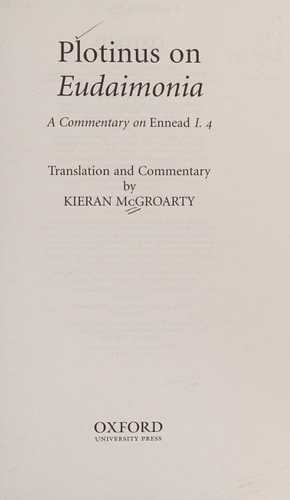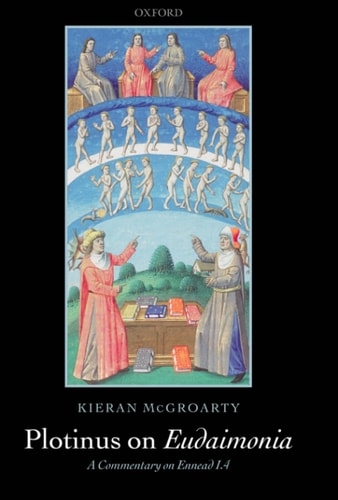
Plotinus on Eudaimonia: A Commentary on Ennead I.4
0
0
As an Amazon Associate and affiliate partner, Menrva Books earns from qualifying purchases. Learn more
Author Description
A philosophical commentary on a section of the Enneads written by the last great Neoplatonist thinker, Plotinus. The treatise is entitled 'Concerning Well-Being' and was written at a late stage in Plotinus' life when he was suffering from an illness that was shortly to kill him. Its main concern is with the good man and how he should pursue the good life. The treatise is therefore central to our understanding of Plotinus' ethical theory, and the commentary seeks to explicate and elucidate that theory. Plotinus' views on how one should live in order to fulfil oneself as a human being are as relevant now as they were in the third century AD. All Greek and Latin is translated, while short summaries introducing the content of each chapter help to make Plotinus' argument clear even to the non-specialist.
Menrva's Summary
THE THESIS
This work investigates the core question of how a human being achieves eudaimonia, or well-being, within the ethical framework of Plotinus' late-stage philosophy. Kieran McGroarty, a scholar of ancient philosophy, provides a detailed analysis of Ennead I.4, a text composed during the final period of Plotinus' life. The commentary examines the philosopher's arguments regarding the nature of the good life and the internal state of the virtuous individual, contextualizing these ideas within the broader Neoplatonic tradition.
THE SCOPE MAP
What You Will Find
- A line-by-line philosophical commentary on Ennead I.4
- Analysis of Plotinus' ethical theory concerning the 'good man'
- English translations of all original Greek and Latin source material
- Chapter-by-chapter summaries designed for accessibility
Scope Limits
- The text is limited to the specific treatise 'Concerning Well-Being' and does not provide a comprehensive overview of the entire Enneads
- The focus remains primarily on ethical theory rather than the metaphysical or cosmological aspects of Plotinus' broader system
THE AUTHORITY PERSPECTIVE
Scholars and students of ancient philosophy frequently cite this work as a helpful resource for navigating the complexities of Plotinus' late-period ethical thought. The text is noted for its clarity and its success in making dense Neoplatonic arguments accessible to non-specialists.
Page Count:
260
Publication Date:
2006-01-01
Publisher:
OUP Oxford
ISBN-10:
0191569437
ISBN-13:
9780191569432
Philosophy
English
English & College Success
Neoplatonism
Ethics