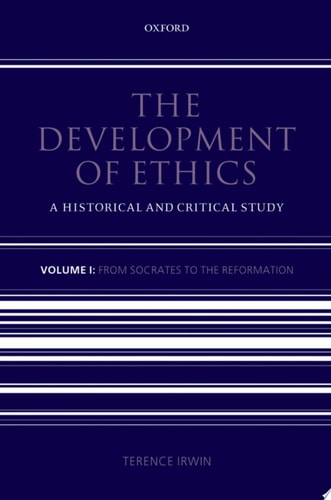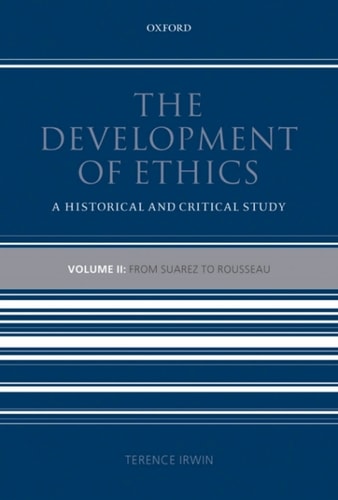
The Development of Ethics: Volume 2: From Suarez to Rousseau
0
0
As an Amazon Associate and affiliate partner, Menrva Books earns from qualifying purchases. Learn more
Author Description
The Development of Ethics is a selective historical and critical study of moral philosophy in the Socratic tradition, with special attention to Aristotelian naturalism. It discusses the main topics of moral philosophy as they have developed historically, including: the human good, human nature, justice, friendship, and morality; the methods of moral inquiry; the virtues and their connexions; will, freedom, and responsibility; reason and emotion; relativism, subjectivism, and realism; the theological aspect of morality. This volume examines early modern moral philosophy from the sixteenth to the eighteenth century. Volume 3 will continue the story up to Rawls's Theory of Justice. The present volume begins with Suarez's interpretation of Scholastic moral philosophy, and examines seventeenth- and eighteenth- century responses to the Scholastic outlook, to see how far they constitute a distinctively different conception of moral philosophy. The treatments of natural law by Grotius, Hobbes, Cumberland, and Pufendorf are treated in some detail. Disputes about moral facts, moral judgments, and moral motivation, are traced through Cudworth, Clarke, Balguy, Hutcheson, Hume, Price, and Reid. Butler's defence of a naturalist account of morality is examined and compared with the Aristotelian and Scholastic views discussed in Volume 1. The volume ends with a survey of the persistence of voluntarism in English moral philosophy, and a brief discussion of the contrasts and connexions between Rousseau and earlier views on natural law. The emphasis of the book is not purely descriptive, narrative, or exegetical, but also philosophical. Irwin discusses the comparative merits of different views, the difficulties that they raise, and how some of the difficulties might be resolved. The book tries to present the leading moral philosophers of the past as participants in a rational discussion that is still being carried on, and tries to help the reader to participate in this discussion.
Menrva's Summary
THE THESIS
This volume investigates how early modern moral philosophy, spanning the sixteenth to the eighteenth century, transitioned from Scholastic frameworks toward distinctively modern conceptions of ethics. Terence Irwin, a prominent scholar of ancient and moral philosophy, utilizes a critical historical approach to evaluate the evolution of moral inquiry. By analyzing the works of figures such as Suarez, Grotius, Hobbes, and Hume, the text argues that these philosophers were engaged in a continuous, rational debate regarding human nature, natural law, and moral motivation that remains relevant to contemporary ethical discourse.
THE SCOPE MAP
What You Will Find
- Analysis of the shift from Scholastic moral philosophy to early modern natural law theories.
- Detailed examinations of Grotius, Hobbes, Cumberland, Pufendorf, Cudworth, Clarke, Balguy, Hutcheson, Hume, Price, Reid, Butler, and Rousseau.
- Philosophical critique of moral realism, voluntarism, and the connection between reason and emotion.
Scope Limits
- The text focuses primarily on the Socratic and Aristotelian traditions, excluding non-Western or non-Socratic ethical systems.
- This volume is limited to the period between the sixteenth and eighteenth centuries, serving as a bridge between the medieval Scholastic outlook and modern theories like those of Rawls.
THE AUTHORITY PERSPECTIVE
Experts recognize this work as a rigorous, high-level contribution to the history of moral philosophy that balances historical exegesis with active philosophical critique. Readers frequently note the academic density of the prose, which is intended for those already familiar with the foundational texts of the Western ethical tradition.
Page Count:
911
Publication Date:
2008-01-01
Publisher:
OUP Oxford
ISBN-10:
0191562408
ISBN-13:
9780191562402
Philosophy
Moral Philosophy
Ethics
Academic
Philosophy history
Community Tags
Similar Books