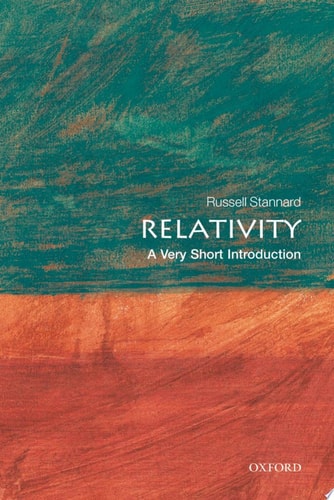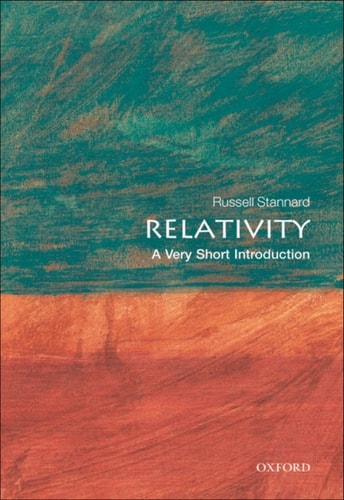
Relativity: A Very Short Introduction
0
0
As an Amazon Associate and affiliate partner, Menrva Books earns from qualifying purchases. Learn more
Author Description
100 years ago, Einstein's theory of relativity shattered the world of physics. Our comforting Newtonian ideas of space and time were replaced by bizarre and counterintuitive conclusions: if you move at high speed, time slows down, space squashes up and you get heavier; travel fast enough and you could weigh as much as a jumbo jet, be squashed thinner than a CD without feeling a thing - and live for ever. And that was just the Special Theory. With the General Theory came even stranger ideas of curved space-time, and changed our understanding of gravity and the cosmos. This authoritative and entertaining Very Short Introduction makes the theory of relativity accessible and understandable. Using very little mathematics, Russell Stannard explains the important concepts of relativity, from E=mc2 to black holes, and explores the theory's impact on science and on our understanding of the universe. ABOUT THE SERIES: The Very Short Introductions series from Oxford University Press contains hundreds of titles in almost every subject area. These pocket-sized books are the perfect way to get ahead in a new subject quickly. Our expert authors combine facts, analysis, perspective, new ideas, and enthusiasm to make interesting and challenging topics highly readable.
Menrva's Summary
THE THESIS
This book investigates the core principles of Albert Einstein's Special and General Theories of Relativity and their implications for our understanding of space, time, and gravity. Russell Stannard, a professor emeritus of physics, utilizes his background in particle physics and science communication to distill complex theoretical frameworks into accessible prose. By minimizing mathematical notation, the author focuses on conceptual clarity to explain how high-speed motion and gravitational fields alter physical reality.
THE SCOPE MAP
What You Will Find
- Explanations of time dilation, length contraction, and mass-energy equivalence.
- Conceptual overviews of curved space-time and gravitational phenomena.
- Discussions on the historical shift from Newtonian mechanics to relativistic physics.
- Insights into the formation and nature of black holes.
Scope Limits
- The text does not provide rigorous mathematical derivations or advanced tensor calculus.
- It does not cover the full breadth of quantum field theory or string theory.
THE AUTHORITY PERSPECTIVE
Experts and educators frequently cite this volume as a premier entry point for laypeople seeking to grasp the fundamental tenets of modern physics. Readers often note that the prose remains highly readable while successfully maintaining scientific accuracy throughout the explanation of counterintuitive concepts.
Page Count:
129
Publication Date:
2008-01-01
Publisher:
OUP Oxford
ISBN-10:
019157404X
ISBN-13:
9780191574047
Science
Non-Fiction
Relativity
Physics
Mathematics Statistics
Cosmology
Mathematics - General