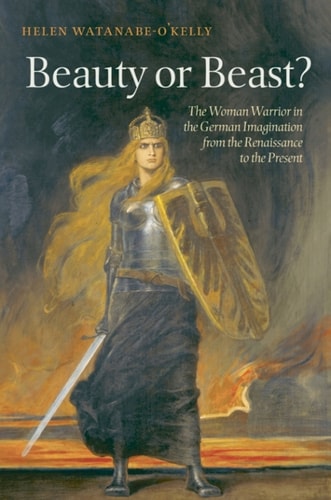
Beauty or Beast?: The Woman Warrior in the German Imagination from the Renaissance to the Present
0
0
As an Amazon Associate and affiliate partner, Menrva Books earns from qualifying purchases. Learn more
Author Description
A regiment of women warriors strides across the battlefield of German culture - on the stage, in the opera house, on the page, and in paintings and prints. These warriors are re-imaginings by men of figures such as the Amazons, the Valkyries, and the biblical killer Judith. They are transgressive and therefore frightening figures who leave their proper female sphere and have to be made safe by being killed, deflowered, or both. This has produced some compelling works of Western culture - Cranach's and Klimt's paintings of Judith, Schiller's Joan of Arc, Hebbel's Judith, Wagner's Brünnhilde, Fritz Lang's Brünhild. Nowadays, representations of the woman warrior are used as a way of thinking about the woman terrorist. Women writers only engage with these imaginings at the end of the 19th century, but from the late 18th century on they begin to imagine fictional cross-dressers going to war in a realistic setting and thus think the unthinkable. What are the roots of these imaginings? And how are they related to Freud's ideas about women's sexuality?
Menrva's Summary
THE THESIS
This work investigates the cultural and historical roots of the woman warrior archetype within German imagination from the Renaissance to the contemporary era. Helen Watanabe-O'Kelly, a scholar of German literature and culture, utilizes a broad range of primary sources including paintings, opera, drama, and literature to analyze how male creators have historically constructed and controlled the image of the transgressive female fighter. The author argues that these figures, ranging from mythological Amazons to biblical killers, are frequently neutralized through violence or sexual subjugation to maintain traditional gender hierarchies.
THE SCOPE MAP
What You Will Find
- Analysis of visual art by figures such as Cranach and Klimt.
- Examination of dramatic and literary works by Schiller, Hebbel, and Wagner.
- Discussion of the transition from mythological archetypes to modern representations of female terrorists.
- Exploration of the intersection between gendered violence and Freudian psychoanalytic theory.
Scope Limits
- The study focuses primarily on German cultural production and does not provide a comprehensive global history of the woman warrior archetype.
- The analysis of female-authored perspectives is limited to the late 19th century and beyond.
THE AUTHORITY PERSPECTIVE
Scholars and critics recognize this text as a significant contribution to the study of gender representation in German cultural history. Readers frequently note the academic rigor and the breadth of the author's interdisciplinary approach to art, literature, and political history.
Page Count:
324
Publication Date:
2010-01-01
Publisher:
Oxford University Press, USA
ISBN-10:
0191576484
ISBN-13:
9780191576485
History
Women and literature
Art History
Gender Studies
In literature
In art
English & College Success
English
German
Literary Criticism
Community Tags
Similar Books