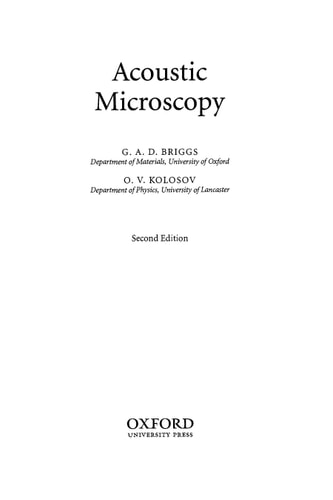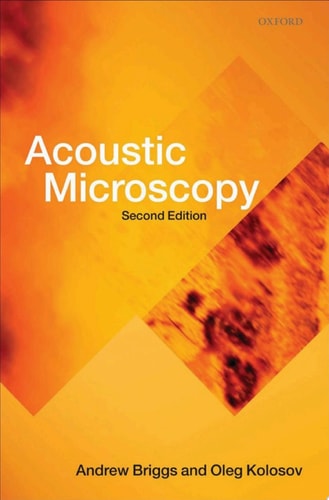
Acoustic Microscopy
0
0
As an Amazon Associate and affiliate partner, Menrva Books earns from qualifying purchases. Learn more
Author Description
Acoustic microscopy enables the elastic properties of materials to be imaged and measured with the resolution of a good microscope. By using frequencies in the microwave regime, it is possible to make the acoustic wavelength comparable with the wavelength of light, and hence to achieve a resolution comparable with an optical microscope. Solids can support both longitudinal and transverse acoustic waves. At surfaces a unique combination of the two known as Raleigh waves can propagate, and in many circumstances these dominate the contrast in acoustic microscopy. Following the invention of scanning probe microscopes, it is now possible to use an atomic force microscope to detect the acoustic vibration of a surface with resolution in the nanometre range, thus beating the diffraction limit by operating in the extreme near-field. This second edition of Acoustic Microscopy has a major new chapter on the technique and applications of acoustically excited probe microscopy.
Menrva's Summary
THE THESIS
This text investigates the physical principles, instrumentation, and practical applications of acoustic microscopy for the characterization of material properties at high resolution. The authors, Andrew Briggs and Oleg Kolosov, leverage their expertise in materials physics to detail how acoustic waves interact with solid surfaces. The book provides a comprehensive framework for understanding wave propagation, diffraction limits, and the integration of scanning probe techniques to achieve nanometer-scale imaging.
THE SCOPE MAP
What You Will Find
- Theoretical foundations of longitudinal, transverse, and Rayleigh waves in solids.
- Technical methodologies for microwave-regime acoustic imaging.
- Integration of atomic force microscopy with acoustic vibration detection.
- Applications of acoustically excited probe microscopy.
Scope Limits
- The text focuses primarily on physical and material science applications rather than biological imaging.
- It assumes a foundational understanding of wave mechanics and solid-state physics.
THE AUTHORITY PERSPECTIVE
Experts recognize this monograph as a definitive reference for researchers and graduate students working in materials characterization. Readers frequently note the technical density of the prose, which serves as a rigorous guide for those applying acoustic techniques in laboratory settings.
Page Count:
384
Publication Date:
2009-01-01
Publisher:
OUP Oxford
ISBN-10:
0191579696
ISBN-13:
9780191579691
Science
Engineering
Physics
Earth Sciences
Technology
Microscopy