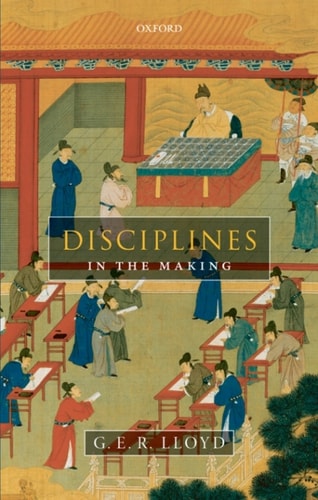
Disciplines in the Making: Cross-Cultural Perspectives on Elites, Learning, and Innovation
0
0
As an Amazon Associate and affiliate partner, Menrva Books earns from qualifying purchases. Learn more
Author Description
The organisation of higher education across the world is one of several factors that conspire to create the assumption that our own map of the intellectual disciplines is, broadly speaking, valid cross-culturally. Disciplines in the Making challenges this in relation to eight main areas of human endeavour, namely philosophy, mathematics, history, medicine, art, law, religion and science. Lloyd focuses on historical and cross-cultural data that throw light on the different ways in which these disciplines were constituted and defined in different periods and civilisations, especially in ancient Greece and China, and how the relationships between them were understood, particularly when one or other discipline claimed hegemonic status (as happened, at different times, with philosophy, history, religion and science). He also explores the role of elites, whether positive (when they foster the professionalisation of a discipline) or negative (when they restrict recruitment to the profession, when they insist on adherence to established norms, concepts and practices and thereby inhibit further innovation). The issues are relevant to current educational policy in relation to the ever-increasing specialisation we see, especially in the sciences, and to the difficulties encountered in making the most of the opportunities for inter- or trans-disciplinary research.
Menrva's Summary
THE THESIS
This work investigates whether the contemporary Western classification of intellectual disciplines is a universal standard or a culturally contingent construct. G. E. R. Lloyd, a distinguished historian of ancient science, utilizes comparative historical data to examine how various fields of knowledge were defined and organized across different civilizations. By analyzing the interplay between elite structures and institutional learning, the author argues that the current boundaries between disciplines are products of specific historical and social pressures rather than objective truths.
THE SCOPE MAP
What You Will Find
- Comparative analysis of eight fields: philosophy, mathematics, history, medicine, art, law, religion, and science.
- Historical case studies focusing primarily on ancient Greece and China.
- Examination of how elite groups influence the professionalization and stagnation of academic fields.
Scope Limits
- The text does not provide a comprehensive global history of all academic disciplines.
- It does not offer a prescriptive manual for modern educational reform.
THE AUTHORITY PERSPECTIVE
Scholars frequently cite this work as a significant contribution to the comparative study of intellectual history and the sociology of knowledge. Readers often note the academic density of the prose, which requires a strong background in historical methodology to fully appreciate the author's nuanced arguments.
Page Count:
224
Publication Date:
2009-01-01
Publisher:
Oxford University Press
ISBN-10:
0191570648
ISBN-13:
9780191570643
Philosophy
History
History & Surveys
Learning and scholarship
Sociology
Universities And Colleges
Education
Intellectual History
Community Tags
Similar Books