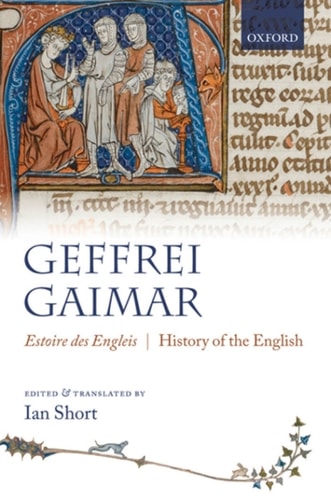
Estoire des Engleis: History of the English
0
0
As an Amazon Associate and affiliate partner, Menrva Books earns from qualifying purchases. Learn more
Author Description
Geffrei Gaimar's Estoire des Engleis is the oldest surviving example of historiography in the French vernacular. It was written in Lincolnshire c.1136-37 and is, in large part, an Anglo-Norman verse adaptation of the Anglo-Saxon Chronicle. Its narrative covers the period from the sixth century until the death of the Conqueror's son William Rufus in 1100. This is an important text in historiographic terms, less as an historical source than as an early example of informative literature written in a secular perspective for a predominantly baronial audience. It illustrates the multilingualism and multiculturalism of twelfth-century Anglo-Norman Britain, and shows the descendants of the Norman conquerors seeking to integrate themselves culturally into their adoptive homeland during the 1130s. It also ranks among the earliest extant witnesses of the rise of courtly literature in French, and of named female literary patronage. This edition offers a critical text of one of the chronicle's four extant manuscripts. There is an introduction placing the poem in its social and literary contexts, followed by the medieval text, edited according to critical interventionist principles and comprising 6532 rhyming octosyllables. A facing modern English prose translation, the first concern of which is accuracy, aims also to convey the tone and style of the original rather than provide a strictly literal rendering of it. The extensive explanatory notes to the text are followed by a bibliography and a complete index of place and personal names.
Menrva's Summary
THE THESIS
This work investigates the development of vernacular historiography in twelfth-century England and the cultural integration of the Anglo-Norman aristocracy. Geffrei Gaimar, writing in the 1130s, adapts the Anglo-Saxon Chronicle into a secular verse narrative to provide a historical framework for a baronial audience. The text serves as a primary case study for the emergence of courtly literature and the influence of female patronage in post-Conquest Britain.
THE SCOPE MAP
What You Will Find
- A critical edition of the Estoire des Engleis based on one of the four extant manuscripts.
- A comprehensive introduction detailing the social and literary context of the twelfth century.
- A facing-page modern English prose translation alongside the original medieval verse.
- Extensive explanatory notes, a bibliography, and a complete index of names.
Scope Limits
- The text functions primarily as a literary and historiographic artifact rather than a strictly accurate historical source for the events described.
- The analysis focuses on the specific manuscript tradition and the linguistic nuances of the Anglo-Norman verse.
THE AUTHORITY PERSPECTIVE
Scholars recognize this edition as a foundational resource for understanding the multilingual nature of Anglo-Norman society and the evolution of secular literature. Readers frequently note the academic density of the prose and the precision of the translation, which successfully balances historical accuracy with the stylistic tone of the original poem.
Page Count:
550
Publication Date:
2009-01-01
Publisher:
Oxford University Press
ISBN-10:
0191570672
ISBN-13:
9780191570674
History
Poetry
European History
Chronicle
Historiography
Community Tags
Similar Books