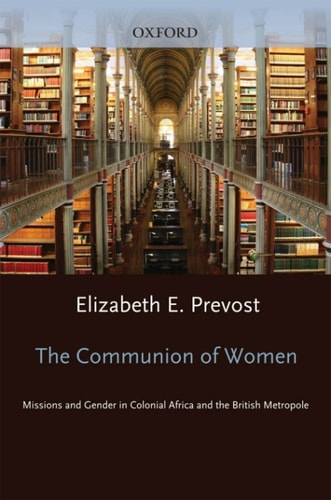
The Communion of Women: Missions and Gender in Colonial Africa and the British Metropole
0
0
As an Amazon Associate and affiliate partner, Menrva Books earns from qualifying purchases. Learn more
Author Description
In the late nineteenth and early twentieth centuries, a number of British women left home to follow a call to the African mission field. Women's involvement in Protestant foreign missions during this time grew out of organized efforts to professionalize women's social services, to promote white women's distinct ability to emancipate 'heathen' women, and to consolidate the religious framework of the British Empire. Motivated women could therefore pursue their vocation in a skilled, independent capacity, confident in the transformative power of the gospel and its institutional counterparts: the Christian home, school, and clinic. Yet women's missions did not transplant British paradigms easily onto African soil. Instead, missionary women encountered competing forms of culture and knowledge that caused them to approach evangelism as a series of negotiations and to rethink preconceived notions of race, gender, and religion. The outcome was a feminized, collaborative framework of Christianity which fostered new opportunities for solidarity and authority among British and African women. So powerful were these individual encounters that they decentred collective representations of empire, patriarchy, progress, and 'civilization.' Missionaries accordingly focused their attentions not only on the overseas mission field, but on the British state and church as sites of regeneration, emancipation, and reform, attempting to build a corporate body around women's Christian authority that would ameliorate the trauma of imperialism and war. Elizabeth Prevost looks at missionaries as the products as well as the agents of the globalization of Christianity, during a time of rapid change at the local, regional, and international level. Anglican women in Madagascar, Uganda, and the British metropole form the basis for this story. Using a rich and largely untapped base of archival and published sources, and encompassing a wide scope of geographical, social, political, and theological cont
Menrva's Summary
THE THESIS
This book investigates how British missionary women in the late nineteenth and early twentieth centuries navigated the intersection of gender, religious vocation, and imperial power to reshape both colonial African societies and the British metropole. Elizabeth E. Prevost, a historian specializing in gender and empire, utilizes extensive archival research to argue that these women were not merely agents of colonial expansion but active participants in a complex, feminized framework of Christianity. By examining the negotiations between British missionaries and African populations, the author demonstrates how these interactions challenged established notions of race, patriarchy, and civilization while fostering new forms of female authority and solidarity.
THE SCOPE MAP
What You Will Find
- Analysis of Anglican missionary activities in Madagascar and Uganda.
- Examination of the professionalization of women's social services within the British Empire.
- Exploration of the 'Christian home, school, and clinic' as institutional tools for evangelism.
- Discussion of the reciprocal influence between the African mission field and the British state and church.
Scope Limits
- The study focuses primarily on Anglican women, excluding a comprehensive analysis of other Protestant or Catholic denominations.
- The narrative centers on the British metropole and specific African regions, rather than providing a global survey of all colonial missionary efforts.
THE AUTHORITY PERSPECTIVE
Historians and scholars of colonial studies frequently cite this work for its rigorous use of untapped archival sources and its nuanced approach to the agency of missionary women. Experts highlight the text as a significant contribution to understanding how gendered religious authority functioned within the broader structures of imperial history.
Page Count:
320
Publication Date:
2010-01-01
Publisher:
OUP Oxford
ISBN-10:
0191573345
ISBN-13:
9780191573347
Religion
History
Colonialism
Great Britain
African history
European History
Gender Studies
British History
Sociology of Religion
Women africa
Community Tags
Similar Books