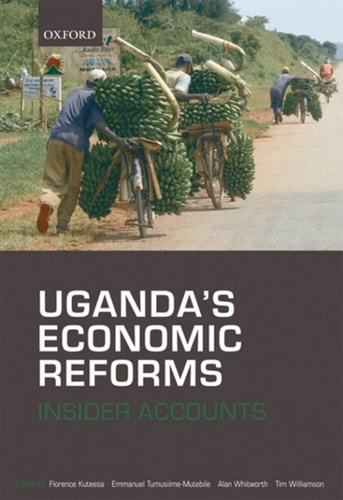
Uganda's Economic Reforms: Insider Accounts
0
0
As an Amazon Associate and affiliate partner, Menrva Books earns from qualifying purchases. Learn more
Author Description
Following the eight year rule of Idi Amin, then several years of war and civil war, the Ugandan economy was in ruins by the time peace was restored in 1986. Since then Uganda has consistently been one of the fastest growing economies in Africa, leading to a substantial reduction in poverty. Its economic success has attracted considerable attention and has arguably had more influence on development thinking and on the international aid architecture than any other country. The HIPC debt relief initiative, the Paris Declaration on Aid Effectiveness, and the growth of budget support have all been strongly influenced by Ugandan experience and thinking. Ugandan innovations such as poverty reduction strategies, public expenditure tracking surveys, and virtual poverty funds have been widely adopted elsewhere. Most of the reforms which transformed the economy originated within the Uganda government during the 1990s, rather than being imposed through donor conditionality. In this book, for the first time many of the architects of those reforms give their personal accounts of the thinking behind the reforms, how they were implemented, and their impact. Since measures that work well in one environment may fail when transplanted to a different environment, the authors identify factors that were critical to the success of Uganda's reforms. While a number of individual reforms have been the subject of academic study, this book represents the first consolidated account of the economic reforms undertaken by the Uganda government and their impact on growth and poverty reduction.
Menrva's Summary
THE THESIS
This book investigates the internal mechanisms and policy decisions that facilitated Uganda's economic recovery and growth following the instability of the 1970s and early 1980s. The authors, including former central bank governor Emmanuel Tumusiime-Mutebile and other key policy architects, provide a firsthand account of the government-led reforms implemented during the 1990s. By examining the transition from a collapsed economy to a model of development, the text argues that local ownership and internal innovation were the primary drivers of success rather than external donor conditionality.
THE SCOPE MAP
What You Will Find
- Analysis of the Ugandan economic recovery post-1986.
- Documentation of policy innovations including poverty reduction strategies and public expenditure tracking.
- Examination of the influence of Ugandan reforms on international aid architecture and debt relief initiatives.
Scope Limits
- The text focuses primarily on government-led economic policy and does not provide an exhaustive social or cultural history of the period.
- It does not offer a comparative analysis of economic failures in neighboring regions.
THE AUTHORITY PERSPECTIVE
Experts and development economists recognize this work as a primary source for understanding the practical implementation of economic reform in post-conflict states. Readers frequently note the technical depth of the prose, which serves as a foundational text for those studying the intersection of national policy and international aid frameworks.
Page Count:
304
Publication Date:
2010-01-01
Publisher:
Oxford University Press
ISBN-10:
0191572233
ISBN-13:
9780191572234
Economics
African history
Public Policy
Community Tags
Similar Books