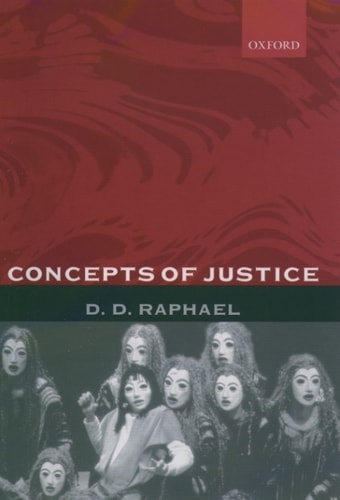
Concepts of Justice
0
0
As an Amazon Associate and affiliate partner, Menrva Books earns from qualifying purchases. Learn more
Author Description
In Concepts of Justice D. D. Raphael gives a philosophical survey of the development of the idea of justice. While the framework is historical, the aim is philosophical analysis and criticism. Part I begins with 'Ancient Roots': justice in the Bible, in Aeschylus' Oresteia, in the philosophers Plato and Aristotle, and among jurists and theologians in the Middle Ages. Part II, 'Modern Shoots', deals with philosophers from Hobbes to Rawls, and others of the modern age. Some of the writings considered will be unfamiliar to many readers, who will find that eminence as a political theorist is neither a necessary nor sufficient condition of significant thought about justice. Part III, 'Historical Fruits', draws some conclusions from the whole survey, pinning down the notion of fairness, and asking why this notion embraces apparently disparate ideas, notably 'merit' and 'need'. The developing role of justice and the emergence of novel features during the last three centuries is also discussed. Raphael does not assume that the theories of philosophers must reflect the thought and usage of people generally: some do while others are idiosyncratic, and a number of philosophers neglect the usage of the concept in the context of law. While this book is not a comprehensive history, it is comprehensive in its scope.
Menrva's Summary
THE THESIS
This book investigates the historical development and philosophical coherence of the concept of justice across Western thought. D. D. Raphael, a noted scholar in political philosophy, utilizes a structured historical framework to analyze how justice has been defined and applied from antiquity to the modern era. By examining both canonical philosophers and lesser-known theorists, the author critiques the evolution of justice as a concept, specifically addressing the tension between merit and need.
THE SCOPE MAP
What You Will Find
- Analysis of ancient sources including the Bible, Aeschylus, Plato, and Aristotle.
- Examination of modern political theorists ranging from Hobbes to Rawls.
- Comparative study of legal, theological, and philosophical interpretations of fairness.
- Synthesis of the relationship between philosophical theory and common usage.
Scope Limits
- The text does not provide a comprehensive or exhaustive history of every legal system.
- It does not attempt to reconcile all idiosyncratic theories into a single unified definition.
THE AUTHORITY PERSPECTIVE
Scholars and students of political theory frequently cite this work as a clear, analytical survey that bridges the gap between historical context and contemporary philosophical debate. Readers often note the accessibility of the prose despite the academic rigor applied to complex ethical concepts.
Page Count:
264
Publication Date:
2001-01-01
Publisher:
Clarendon Press
ISBN-10:
0191588075
ISBN-13:
9780191588075
Philosophy
Legal Theory
Ethics
Political Theory
History of Ideas
Community Tags
Other Editions(3)


Similar Books