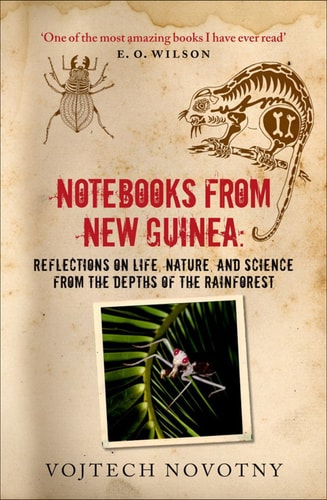
Notebooks from New Guinea: Reflections on Life, Nature, and Science from the Depths of the Rainforest
0
0
As an Amazon Associate and affiliate partner, Menrva Books earns from qualifying purchases. Learn more
Author Description
This is a unique and delightfully engaging account by a leading tropical biologist of doing science at one of the last wild frontiers in the world. Vojtech Novotny is a highly respected Czech scientist. His widely cited work, of profound importance to ecology and evolution, is not done, like much modern science, in a lab full of gleaming apparatus. Instead, he chose as his 'laboratory' the remotest parts of Papua New Guinea, where he has established a research station. Supported by a team of Papuans whom he has trained up so that they can combine their wide and intimate knowledge of the plants and animals of their tropical forest with the knowledge of modern science, Novotny studies the ecological interactions of butterflies and plants. Clearly this is no ordinary scientist. Combined with his intrepid courage (PNG is one of the most dangerous places on Earth, with a very high homicide rate), he is a shrewd observer of human nature. In the richly varied notes and reflections of this very individual volume are not only descriptions of natural history and scientific research in the rainforest, but accounts of the local peoples and their culture, the challenges of working across very different cultures, and amusing portraits of the antics of Western tourists, separated by a few 'intermezzi' - episodes when the author fought bouts of malaria. Novotny is that rare combination of excellent scientist and superb storyteller. The faithful translations by David Short bring these notes and reflections on science, nature, and human beings to a wide audience, without any loss to their richness, warmth, humility, and wisdom. The volume is illustrated with beautiful drawings by a self-taught Papuan artist, Benson Avea Bego, who lives in a remote village.
Menrva's Summary
THE THESIS
How does the practice of field biology function within the complex intersection of remote wilderness, indigenous collaboration, and cross-cultural exchange? Vojtech Novotny, a prominent tropical biologist, documents his experiences establishing a research station in Papua New Guinea. Through a series of personal reflections, he examines the logistical and intellectual challenges of conducting rigorous ecological studies on plant-insect interactions while navigating the social and environmental realities of one of the world's most isolated regions.
THE SCOPE MAP
What You Will Find
- Observations on the ecological relationships between butterflies and tropical flora
- Methodologies for training and collaborating with local Papuan research teams
- Anecdotal accounts of cross-cultural communication and the challenges of remote field work
- Personal reflections on the intersection of Western scientific practice and indigenous knowledge
Scope Limits
- The text does not provide a comprehensive academic textbook on tropical ecology
- It does not offer a systematic historical analysis of Papua New Guinea beyond the author's personal experiences
THE AUTHORITY PERSPECTIVE
Experts and readers alike value this work for its rare synthesis of rigorous scientific inquiry and accessible, humanistic storytelling. The text is frequently cited for its unique perspective on the collaborative nature of modern field biology and the humility required to work effectively in diverse cultural landscapes.
Page Count:
270
Publication Date:
2009-01-01
Publisher:
OUP Oxford
ISBN-10:
0191580325
ISBN-13:
9780191580321
Biography
Travel
Science
Nature
Anthropology
New Guinea
Ecology
Community Tags
Similar Books