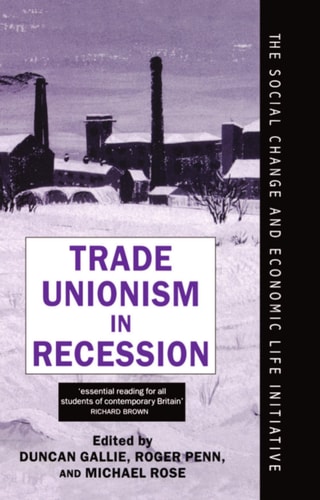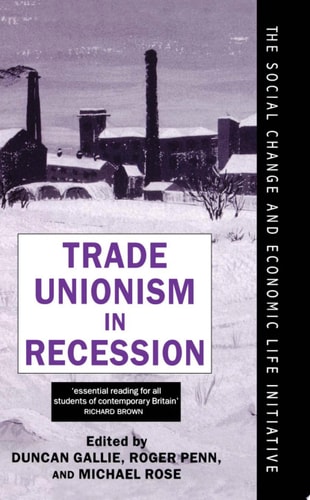
Trade Unionism in Recession
0
0
As an Amazon Associate and affiliate partner, Menrva Books earns from qualifying purchases. Learn more
Author Description
During The 1980's, British Trade Unionism Confronted Its Greatest Challenge, And Suffered Its Greatest Reverses, Since The Inter-war Period. After A Decade Of Rapid Growth, The Unions Experienced A Steep Decline In Membership, And A Virtual Marginalization In National Political Affairs. By 1990, A United, Self-confident, Social Movement As Well As A Powerful Industrial Bargainer, Often Seemed More Closely Akin To A Demoralized Collection Of Special Interest Groupings. This Book Addresses A Number Of Fundamental Questions Raised By The Record Of These Years. It Examines The Reasons For Membership Loss And The Implications For Trade Union Influence In The Workplace. It Looks At The Steps The Unions Took In Reaction To The Membership Problem And The Difficulties They Confronted Doing So. It Also Looks At Whether This Period Can Be Seen As Making A Fundamental Break With The Past, Resulting In Irretrievable Loss By British Trade Unionism Of Its Former Important Position In British Society And The British Workplace, Or Whether The Past Decade Has Been But A Temporary Recession And The Future Can Still See Revived Movement.
Menrva's Summary
THE THESIS
This book investigates the factors contributing to the decline of British trade unionism during the 1980s and evaluates whether this period represents a permanent structural shift or a temporary economic downturn. The authors, Duncan Gallie, Michael Rose, and Roger Penn, utilize empirical data and industrial relations research to analyze the erosion of union membership and political influence. They construct a framework that assesses both internal organizational responses and external socio-economic pressures to determine the long-term viability of the labor movement in the United Kingdom.
THE SCOPE MAP
What You Will Find
- Analysis of membership decline trends in British trade unions during the 1980s
- Examination of union influence within the workplace and national political spheres
- Evaluation of strategic responses implemented by unions to combat membership loss
- Comparative assessment of historical labor trends versus the 1980s recession
Scope Limits
- The study focuses primarily on the British context and does not provide a global comparative analysis of labor movements
- The research concludes its primary analysis around 1990 and does not cover subsequent developments in the 21st century
THE AUTHORITY PERSPECTIVE
Experts recognize this work as a significant sociological and economic analysis of the Thatcher-era labor landscape. Readers frequently note the academic density of the prose, which provides a rigorous examination of industrial relations for scholars and students of British history.
Page Count:
376
Publication Date:
1996-01-01
Publisher:
Oup Oxford
ISBN-10:
0191584347
ISBN-13:
9780191584343
Economics
Labor Relations
British History
Sociology