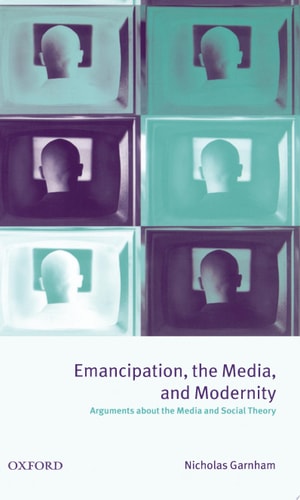
Emancipation, The Media, and Modernity: Arguments About the Media and Social Theory
0
0
As an Amazon Associate and affiliate partner, Menrva Books earns from qualifying purchases. Learn more
Author Description
This Book Adopts A Polemical Stance. It Approaches The Problems Raised By The Media By Way Of A Set Of Arguments With The Two Dominant Paradigms Now Current For Thinking About The Mediadspost-modernism And Information Society Theory. It Argues That The Media Are Important Because They Raise A Set Of Questions That Have Been Central To Social And Political Theory Since The Enlightenment. In A Series Of Probes Into Different Sets Of Questions Raised By The Media, The Argument Of The Book Focuses On The Problem Raised By What Kant Called The Unsocial Sociability Of Human Kind. Under What Conditions Could Autonomous, Free Individuals Live In Viable Social Communities. Or To Put It Another Way What Are The Related Scope For, And Limits On, Human Reason And Emancipation. In Conducting This Argument The Book First Argues For A Necessarily Historical Perspective. It Then Goes On To Examine The Implications For Emancipation Of Seeing The Media As Cultural Industries Within The Wider Systems World Of The Capitalist Market Economy; Of Seeing The Media As Technologies; Of The Specialisation Of Intellectual Production And Of The Separation And Increasing Social Distance Between The Producers And Consumers Of Symbols. It Then Goes On To Argue, Against Current Ethnographic Trends In Audience Research And Against The Focus On Everyday Life, For A Reinstatement Of Interest In The Statistical Reality Of Audiences And Effects, And For A Recognition Through A Return To The Hegelian Roots Of Commodity Fetishism, And The Symbolic Interactionist Creation Of Identities, That An Active Audience Can Be Actively Involved In Its Own Domination. The Argument Then Turns To The Problem Of How We Evaluate The Symbolic Forms That The Media Circulate And Whether Such Evaluation Can Be Anything More Than A Matter Of Personal Taste. It Is Argued That Evaluation Is In Practice Unavoidable And Without Some Standards That Are More Than Just Subjective Any Criticism Of The Medias Performance Is Impossible
Menrva's Summary
THE THESIS
This work investigates the role of media in modern society by challenging the dominant paradigms of post-modernism and information society theory. Nicholas Garnham, a scholar of political economy and media, utilizes a historical and materialist framework to examine how media systems intersect with Enlightenment ideals of human reason and emancipation. He argues that media must be understood as cultural industries operating within capitalist market economies, necessitating a critical re-evaluation of how symbolic production influences social autonomy.
THE SCOPE MAP
What You Will Find
- Analysis of media as cultural industries within capitalist systems
- Critique of ethnographic trends in audience research
- Re-examination of Hegelian commodity fetishism in symbolic production
- Theoretical inquiry into the limits of human reason and social community
Scope Limits
- Does not provide a comprehensive history of media technology development
- Avoids purely subjective or aesthetic evaluations of media content
THE AUTHORITY PERSPECTIVE
Scholars and students of media theory frequently identify this text as a rigorous critique of contemporary cultural studies and audience research methodologies. Experts highlight the author's commitment to political economy as a necessary counterpoint to the focus on everyday life and individual identity in modern media analysis.
Page Count:
214
Publication Date:
2000-01-01
Publisher:
Oup Oxford
ISBN-10:
0191584193
ISBN-13:
9780191584190
Social Theory
Communication Studies
Sociology
Media Studies
Community Tags
Other Editions(2)
Similar Books

Reader Comments
Share Your Thoughts
No comments yet. Be the first to share your thoughts!