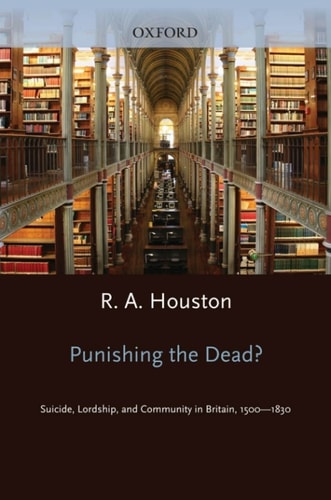
Punishing the Dead?: Suicide, Lordship, and Community in Britain, 1500-1830
0
0
As an Amazon Associate and affiliate partner, Menrva Books earns from qualifying purchases. Learn more
Author Description
What can we learn from suicide, that most personal and often inscrutable of acts? This strikingly original work shows how, from treatment of suicides in historic Britain, unique insights can be gained into the development of both social and political relationships and cultural attitudes in a period of profound change. Drawing ideas from a range of disciplines including law, philosophy, the social sciences, and literary studies as well as history, the book comprehensively analyses how successful and attempted suicide was viewed by the living and how they dealt with its aftermath, using a wide variety of legal, fiscal, and literary sources. By investigating the distinctive institutional environments and mental worlds of early modern England and Scotland, it explains why suicide was treated as a crime subject to financial and corporal punishments, and it questions modern assumptions about the apparent 'enlightenment' of attitudes in the eighteenth century. The book is divided into two parts. Part one examines the role of lordship in managing social and economic relationships following suicide and illuminates the importance of distinctive punishments inflicted on suicides' bodies for understanding historic communities. The second part of the book places suicide in its cultural context, analysing the attitudes of early modern people to those who killed themselves. It explores religious beliefs and the place of the devil as well as secular and medical understandings of suicide's causes in sources that include provincial newspapers. Informed by continental as well as British research, Punishing the Dead? explicitly compares England and Scotland, making this a completely British history. It also offers intriguing evidence for the importance of cultural regions and local vernaculars that transcend national boundaries.
Menrva's Summary
THE THESIS
This work investigates how the legal, social, and cultural treatment of suicide in Britain between 1500 and 1830 reflects broader shifts in political authority and community values. R. A. Houston, a historian specializing in early modern Europe, utilizes a multidisciplinary framework to examine how suicide was categorized as a crime and managed through fiscal and corporal punishment. By synthesizing legal records, fiscal documents, and literary sources, the author challenges the narrative of a linear progression toward enlightened attitudes during the eighteenth century.
THE SCOPE MAP
What You Will Find
- Comparative analysis of legal and social responses to suicide in England and Scotland.
- Examination of the role of lordship in managing the aftermath of self-inflicted death.
- Analysis of religious, secular, and medical interpretations of suicide causes.
- Integration of provincial newspaper reports and historical legal archives.
Scope Limits
- The study is geographically restricted to Britain and does not provide a global history of suicide.
- The analysis focuses primarily on the early modern period, concluding at 1830.
THE AUTHORITY PERSPECTIVE
Scholars recognize this monograph as a rigorous contribution to the social history of early modern Britain, particularly for its comparative approach to English and Scottish legal traditions. Readers frequently note the academic density of the prose, which serves as a foundational resource for researchers interested in the intersection of law, culture, and mentalities.
Page Count:
528
Publication Date:
2010-01-01
Publisher:
OUP Oxford
ISBN-10:
0191585122
ISBN-13:
9780191585128
History
Sociology
Great Britain
Social History
European History
Suicide
Legal History
Early Modern
Community Tags
Similar Books