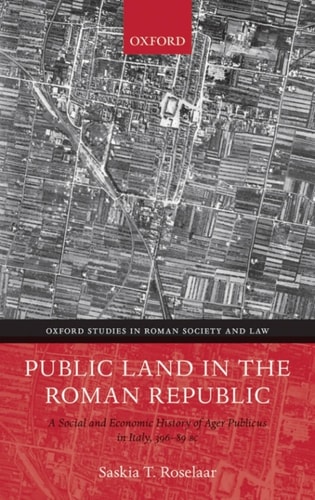
Public Land in the Roman Republic: A Social and Economic History of Ager Publicus in Italy, 396-89 BC
0
0
As an Amazon Associate and affiliate partner, Menrva Books earns from qualifying purchases. Learn more
Author Description
In the first volume in this new series on Roman society and law, Saskia T. Roselaar traces the social and economic history of the ager publicus, or public land. As the Romans conquered Italy during the fourth to first centuries BC, they usually took land away from their defeated enemies and declared this to be the property of the Roman state. This land could be distributed to Roman citizens, but it could also remain in the hands of the state, in which case it was available for general public use. However, in the third and second centuries BC growth in the population of Italy led to an increased demand for land among both commercial producers and small farmers. This in turn led to the gradual privatization of the state-owned land, as those who held it wanted to safeguard their rights to it. Roselaar traces the currents in Roman economy and demography which led to these developments.
Menrva's Summary
THE THESIS
This work investigates the social and economic evolution of ager publicus, or public land, within the Roman Republic and its impact on the development of Italian land ownership. Saskia T. Roselaar, a specialist in Roman history, utilizes archaeological data, epigraphic evidence, and literary sources to construct a comprehensive analysis of how state-owned territory was managed, distributed, and eventually privatized. The book argues that demographic shifts and commercial pressures in the third and second centuries BC were the primary drivers behind the transition from state-held land to private holdings.
THE SCOPE MAP
What You Will Find
- Analysis of Roman land acquisition policies following military conquests in Italy.
- Examination of the tension between small-scale farmers and commercial agricultural producers.
- Detailed study of the legal and economic mechanisms governing state land usage.
Scope Limits
- The study is geographically restricted to the Italian peninsula.
- The chronological scope is limited to the period between 396 BC and 89 BC.
THE AUTHORITY PERSPECTIVE
Scholars recognize this text as a foundational contribution to the study of Roman agrarian policy and economic history. Readers frequently note the academic density of the prose, which provides a rigorous examination of complex land tenure systems for advanced students and researchers.
Page Count:
480
Publication Date:
2010-01-01
Publisher:
OUP Oxford
ISBN-10:
0191591483
ISBN-13:
9780191591488
History
Land Use
Public lands
Ancient History
Economic History
Law
Roman History
Social History
Community Tags
Similar Books