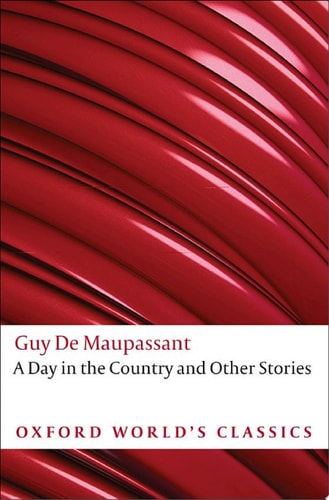
A Day in the Country and Other Stories
0
0
As an Amazon Associate and affiliate partner, Menrva Books earns from qualifying purchases. Learn more
Author Description
This selection of twenty-seven stories shows Maupassant at his comic, cruel, and brilliant best. In addition to the poignant title story, it includes one of the most famous tales ever written, The Necklace, and Le Horla, an account of a disintegrating personality that chillingly parallels the author's own decline into madness. All the stories demonstrate his genius for invention and his ability to write unblinkingly about the absurdity of the human condition, supporting Henry James' claim that in the annals of story-telling, Maupassant stands `like a lion in the path'. ABOUT THE SERIES: For over 100 years Oxford World's Classics has made available the widest range of literature from around the globe. Each affordable volume reflects Oxford's commitment to scholarship, providing the most accurate text plus a wealth of other valuable features, including expert introductions by leading authorities, helpful notes to clarify the text, up-to-date bibliographies for further study, and much more.
Menrva's Summary
THE PULSE
This collection of twenty-seven short stories captures the stark realities and moral complexities of nineteenth-century French life through the lens of Guy de Maupassant. The protagonist in each narrative faces distinct social, psychological, or existential pressures that force a confrontation with their own limitations or the hypocrisy of their environment. Maupassant employs a detached, observational framework that allows the irony of human behavior to emerge without overt authorial intervention. The stories range from domestic dramas to psychological horror, consistently highlighting the fragility of social standing and mental stability.
INSIDE THE PAGES
- Concise, objective prose style characteristic of French Realism
- Sharp, ironic observations regarding social class and status
- Exploration of psychological deterioration and mental instability
- Focus on the absurdity and cruelty inherent in human interactions
- Use of surprise endings to subvert reader expectations
- Vivid depictions of rural and urban French settings
- Inclusion of seminal works such as The Necklace and Le Horla
- Scholarly introduction and critical notes provided by Oxford World's Classics
THE COLLECTIVE ECHO
Readers and critics frequently highlight Maupassant's ability to condense complex human experiences into brief, impactful narratives. Discussion often centers on his clinical, unblinking approach to the darker aspects of the human condition, which avoids sentimentality in favor of raw observation. Many appreciate the balance between his biting social satire and the more haunting, psychological depth found in his later works. The collection is widely regarded as an effective entry point for those interested in the evolution of the short story form during the nineteenth century.
Page Count:
337
Publication Date:
1998-01-01
Publisher:
OUP Oxford
ISBN-10:
0191606006
ISBN-13:
9780191606007
Fiction
French literature
English & College Success
English
Short Stories
Classic Literature
Realism
Community Tags
Similar Books