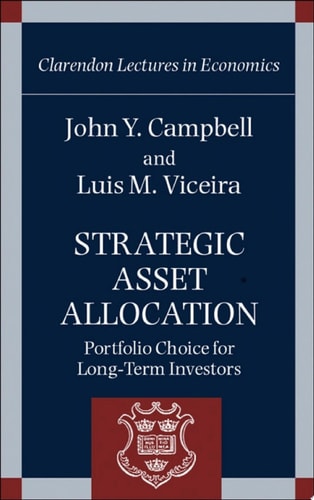
Strategic Asset Allocation: Portfolio Choice for Long-Term Investors
0
0
As an Amazon Associate and affiliate partner, Menrva Books earns from qualifying purchases. Learn more
Author Description
Academic finance has had a remarkable impact on many financial services. Yet long-term investors have received curiously little guidance from academic financial economists. Mean-variance analysis, developed almost fifty years ago, has provided a basic paradigm for portfolio choice. This approach usefully emphasizes the ability of diversification to reduce risk, but it ignores several critically important factors. Most notably, the analysis is static; it assumes that investors care only about risks to wealth one period ahead. However, many investors---both individuals and institutions such as charitable foundations or universities---seek to finance a stream of consumption over a long lifetime. In addition, mean-variance analysis treats financial wealth in isolation from income. Long-term investors typically receive a stream of income and use it, along with financial wealth, to support their consumption. At the theoretical level, it is well understood that the solution to a long-term portfolio choice problem can be very different from the solution to a short-term problem. Long-term investors care about intertemporal shocks to investment opportunities and labor income as well as shocks to wealth itself, and they may use financial assets to hedge their intertemporal risks. This should be important in practice because there is a great deal of empirical evidence that investment opportunities---both interest rates and risk premia on bonds and stocks---vary through time. Yet this insight has had little influence on investment practice because it is hard to solve for optimal portfolios in intertemporal models. This book seeks to develop the intertemporal approach into an empirical paradigm that can compete with the standard mean-variance analysis. The book shows that long-term inflation-indexed bonds are the riskless asset for long-term investors, it explains the conditions under which stocks are safer assets for long-term than for short-term investors, and it shows how labo
Menrva's Summary
THE THESIS
This book investigates how long-term investors can optimize portfolio choices by moving beyond static mean-variance analysis to account for intertemporal risks and labor income. John Y. Campbell and Luis M. Viceira, both distinguished scholars in financial economics, utilize empirical evidence and mathematical modeling to address the limitations of traditional investment paradigms. They argue that long-term investors face unique challenges, such as fluctuating interest rates and varying risk premia, which require a more dynamic approach to asset allocation.
THE SCOPE MAP
What You Will Find
- Intertemporal models for portfolio choice
- Analysis of inflation-indexed bonds as riskless assets
- Empirical evidence on time-varying investment opportunities
- Integration of labor income into wealth management strategies
Scope Limits
- The text focuses primarily on theoretical and empirical frameworks rather than practical day-to-day trading strategies for retail investors.
THE AUTHORITY PERSPECTIVE
Experts recognize this work as a foundational text for understanding the transition from static to intertemporal portfolio theory. Readers frequently note the academic density of the prose, which is intended for graduate-level students and professional financial researchers.
Page Count:
274
Publication Date:
2002-01-01
Publisher:
OUP Oxford
ISBN-10:
019160691X
ISBN-13:
9780191606915
Economics
Academic
Investment
Finance
Community Tags
Similar Books


Reader Comments
Share Your Thoughts
No comments yet. Be the first to share your thoughts!