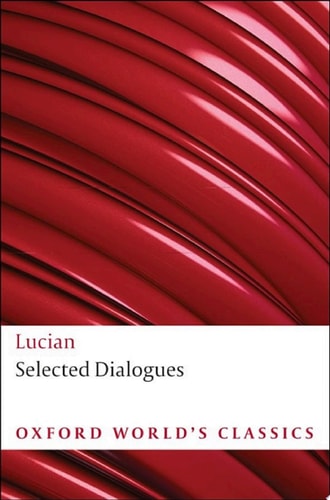
Selected Dialogues
0
0
As an Amazon Associate and affiliate partner, Menrva Books earns from qualifying purchases. Learn more
Author Description
'you'll find another man to harvest, Glycerion: let this one go' The Greek satirist Lucian was a brilliantly entertaining writer who invented the comic dialogue as a vehicle for satiric comment. His influence was immense, not only in the Greek world, but on later European writers such as Rabelais and Swift. His dialogues puncture the pretensions of pompous philosophers and describe the daily lives of Greek courtesans; they are peopled by politicians, historians and ordinary citizens, as well as by gods and mythic figures. This selection provides a cross-section of Lucian's styles and satirical targets, from serious polemic to lighter squibs and character portrayals. It includes How to Write History and his most famous piece, A True History, a fabulous tale of space travel and a monstrous whale which prefigures the fantasies of Jules Verne. This lively new translation is both accurate and idiomatic, and the introduction highlights Lucian's importance in his own and later times. ABOUT THE SERIES: For over 100 years Oxford World's Classics has made available the widest range of literature from around the globe. Each affordable volume reflects Oxford's commitment to scholarship, providing the most accurate text plus a wealth of other valuable features, including expert introductions by leading authorities, helpful notes to clarify the text, up-to-date bibliographies for further study, and much more.
Menrva's Summary
THE PULSE
The central conflict involves the systematic dismantling of intellectual, social, and religious pretension through the sharp, ironic lens of Lucian’s satirical dialogues. Lucian utilizes the dialogue format to challenge the authority of contemporary philosophers, the vanity of public figures, and the absurdity of mythological traditions. His objective is to expose the gap between human behavior and societal ideals, often employing a cynical yet humorous tone to highlight human folly. The narrative framework varies across the collection, shifting between direct philosophical debate, observational character sketches, and fantastical, non-linear storytelling. These pieces operate within the constraints of the Second Sophistic period, blending traditional Greek rhetorical styles with innovative, irreverent narrative structures.
INSIDE THE PAGES
- Use of the comic dialogue as a primary vehicle for social critique
- Inclusion of A True History, an early example of speculative fiction and space travel
- Direct satire targeting the pomposity of ancient philosophical schools
- Character-driven vignettes featuring courtesans, politicians, and common citizens
- Integration of mythological figures into mundane or absurd scenarios
- Stylistic variety ranging from serious polemic to lighthearted squibs
- Meta-fictional commentary on the craft of writing history
- Idiomatic translation that preserves the wit of the original Greek
THE COLLECTIVE ECHO
Discussion often centers on Lucian’s role as a bridge between ancient rhetorical traditions and the development of modern satirical literature. Readers frequently highlight the accessibility of these dialogues, noting that the humor remains effective despite the historical distance of the source material. Critics often point to the balance between his biting social commentary and the imaginative, almost surreal elements found in his more fantastical works. The collection is widely regarded as a significant entry point for those interested in the evolution of comic prose and the influence of Greek satire on later European writers like Swift and Rabelais.
Page Count:
296
Publication Date:
2006-01-01
Publisher:
OUP Oxford
ISBN-10:
0191604798
ISBN-13:
9780191604799
Philosophy
Humor
Satire
English & College Success
Classical
English
Community Tags
Similar Books