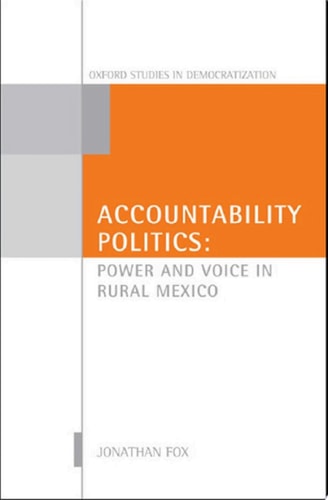
Accountability Politics: Power and Voice in Rural Mexico
0
0
As an Amazon Associate and affiliate partner, Menrva Books earns from qualifying purchases. Learn more
Author Description
How can the seeds of accountability ever grow in authoritarian environments? Embedding accountability into the state is an inherently uneven, partial and contested process. Campaigns for public accountability often win limited concessions at best, but they can leave cracks in the system that serve as handholds for subsequent efforts to open up the state to public scrutiny. This book explores the how civil society "thickens" by comparing two decades of rural citizens' struggles to hold the Mexican state accountable, exploring both change and continuity before, during, and after national electoral turning points. The book addresses how much power-sharing really happens in policy innovations that include participatory social and environmental councils, citizen oversight of elections, local government social investment funds, participation reforms in World Bank projects, community-managed food programs, as well as new social oversight and public information access reforms. Meanwhile, efforts to exercise voice unfold at the same time as rural citizens consider their exit options, as millions migrate to the US, where many have since come together in a new migrant civil society. Since explanations of electoral change do not account for how people actually experience the state, this book concludes that new analytical frameworks are needed to understand "transitions to accountability." This involves unpacking the interaction between participation, transparency and accountability. Oxford Studies in Democratization is a series for scholars and students of comparative politics and related disciplines. Volumes concentrate on the comparative study of the democratization process that accompanied the decline and termination of the cold war. The geographical focus of the series is primarily Latin America, the Caribbean, Southern and Eastern Europe, and relevant experiences in Africa and Asia. The series editor is Laurence Whitehead, Official Fellow, Nuffield College, University of O
Menrva's Summary
THE THESIS
How can the seeds of accountability grow within authoritarian environments, and what mechanisms allow civil society to influence state transparency? Jonathan A. Fox, a scholar of Latin American politics, utilizes two decades of empirical research on rural Mexican social movements to argue that accountability is an uneven, contested process rather than a linear transition. He proposes a new analytical framework that examines the interaction between participation, transparency, and accountability to explain how citizens experience and challenge the state beyond electoral shifts.
THE SCOPE MAP
What You Will Find
- Comparative analysis of rural social struggles in Mexico across two decades.
- Evaluation of policy innovations including participatory councils, social investment funds, and community-managed food programs.
- Examination of the intersection between domestic civil society and migrant activism in the United States.
Scope Limits
- The study focuses primarily on rural Mexico and does not provide a comprehensive analysis of urban political dynamics.
- The research does not cover post-2007 developments in Mexican democratization.
THE AUTHORITY PERSPECTIVE
Scholars in comparative politics identify this work as a significant contribution to the study of state-society relations and institutional reform. Readers frequently note the academic density of the prose, which is intended for an audience of researchers and students of democratization.
Page Count:
312
Publication Date:
2007-01-01
Publisher:
OUP Oxford
ISBN-10:
0191607266
ISBN-13:
9780191607264
Sociology
American Studies
Local government
Public Policy
Civil society
Community Tags
Other Editions(2)
Similar Books








Reader Comments
Share Your Thoughts
No comments yet. Be the first to share your thoughts!