
Aristotle on the Common Sense
0
0
As an Amazon Associate and affiliate partner, Menrva Books earns from qualifying purchases. Learn more
Author Description
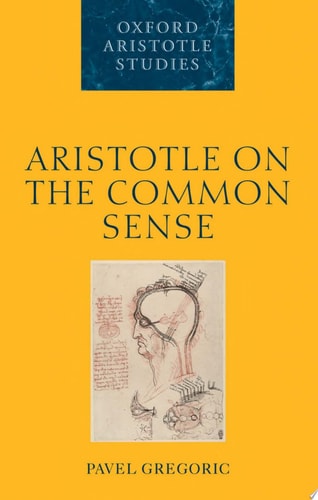
Apart from using our eyes to see and our ears to hear, we regularly and effortlessly perform a number of complex perceptual operations that cannot be explained in terms of the five senses taken individually. Such operations include, for example, perceiving that the same object is white and sweet, noticing the difference between white and sweet, or knowing that one's senses are active. Observing that lower animals must be able to perform such operations, and being unprepared to ascribe any share in rationality to them, Aristotle explained such operations with reference to a higher-order perceptual capacity which unites and monitors the five senses. This capacity is known as the 'common sense' or sensus communis. Unfortunately, Aristotle provides only scattered and opaque references to this capacity. It is hardly surprising, therefore, that the exact nature and functions of this capacity have been a matter of perennial controversy. Pavel Gregoric offers an extensive and compelling treatment of the Aristotelian conception of the common sense, which has become part and parcel of Western psychological theories from antiquity through to the Middle Ages, and well into the early modern period. Aristotle on the Common Sense begins with an introduction to Aristotle's theory of perception and sets up a conceptual framework for the interpretation of textual evidence. In addition to analysing those passages which make explicit mention of the common sense, and drawing out the implications for Aristotle's terminology, Gregoric provides a detailed examination of each function of this Aristotelian faculty.
Menrva's Summary
THE THESIS
This book investigates the nature and functions of the Aristotelian 'common sense' (sensus communis) to resolve long-standing scholarly controversies regarding its role in perception. Pavel Gregoric, a scholar of ancient philosophy, utilizes a rigorous analysis of Aristotle's scattered and often opaque texts to reconstruct a coherent theory of this higher-order perceptual capacity. By situating the common sense within the broader context of Aristotle's psychological and biological works, the author provides a systematic framework for understanding how the ancients accounted for complex perceptual operations that transcend individual sensory input.
THE SCOPE MAP
What You Will Find
- A comprehensive analysis of Aristotle's theory of perception and its terminology.
- A detailed examination of the specific functions attributed to the common sense, such as cross-modal perception and self-awareness.
- A historical overview of how this concept influenced Western psychological theories from antiquity through the early modern period.
Scope Limits
- The text does not provide a general biography of Aristotle or a broad survey of his entire philosophical corpus.
- It focuses specifically on the 'common sense' faculty rather than an exhaustive treatment of all Aristotelian cognitive faculties.
THE AUTHORITY PERSPECTIVE
Scholars and students of ancient philosophy frequently cite this work as a primary resource for navigating the complexities of Aristotelian psychology. Readers often note the academic density of the prose, which is designed for those with a background in classical studies or philosophy.
Page Count:
266
Publication Date:
2007-01-01
Publisher:
Clarendon Press
ISBN-10:
0191608491
ISBN-13:
9780191608490
Philosophy
Common sense
History of Psychology
History & Surveys
Aristotle
Community Tags
Other Editions(4)

Similar Books



Reader Comments
Share Your Thoughts
No comments yet. Be the first to share your thoughts!