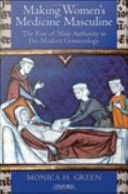
Making Women's Medicine Masculine: The Rise of Male Authority in Pre-Modern Gynaecology
0
0
As an Amazon Associate and affiliate partner, Menrva Books earns from qualifying purchases. Learn more
Author Description
Making Women's Medicine Masculine challenges the common belief that prior to the eighteenth century men were never involved in any aspect of women's healthcare in Europe. Using sources ranging from the writings of the famous twelfth-century female practitioner, Trota of Salerno, all the way to the great tomes of Renaissance male physicians, and covering both medicine and surgery, this study demonstrates that men slowly established more and more authority in diagnosing and prescribing treatments for women's gynaecological conditions (especially infertility) and even certain obstetrical conditions. Even if their 'hands-on' knowledge of women's bodies was limited by contemporary mores, men were able to establish their increasing authority in this and all branches of medicine due to their greater access to literacy and the knowledge contained in books, whether in Latin or the vernacular. As Monica Green shows, while works written in French, Dutch, English, and Italian were sometimes addressed to women, nevertheless even these were often re-appropriated by men, both by practitioners who treated women and by laymen interested to learn about the 'secrets' of generation. While early in the period women were considered to have authoritative knowledge on women's conditions (hence the widespread influence of the alleged authoress 'Trotula'), by the end of the period to be a woman was no longer an automatic qualification for either understanding or treating the conditions that most commonly afflicted the female sex - with implications of women's exclusion from production of knowledge on their own bodies extending to the present day.
Menrva's Summary
THE THESIS
This study investigates the historical transition of gynaecological authority from female practitioners to male physicians in pre-modern Europe. Monica H. Green, a historian of medicine, analyzes a wide array of texts ranging from the twelfth-century writings of Trota of Salerno to Renaissance medical treatises. She argues that male physicians leveraged their superior access to literacy and Latin-based medical knowledge to marginalize female expertise, ultimately redefining the treatment of women's health as a masculine domain.
THE SCOPE MAP
What You Will Find
- Analysis of medical and surgical texts from the twelfth to the sixteenth centuries.
- Examination of the shift in authority regarding infertility and obstetrical conditions.
- Discussion of the re-appropriation of vernacular medical literature by male practitioners and laymen.
Scope Limits
- The study focuses primarily on European medical history and does not provide a global survey of gynaecological practices.
- It does not cover the clinical outcomes of these treatments, focusing instead on the production and control of medical knowledge.
THE AUTHORITY PERSPECTIVE
Scholars in the history of medicine recognize this work as a foundational text for understanding the gendered nature of medical knowledge production. Readers frequently note the academic density of the prose and the meticulous archival research that supports Green's arguments regarding the exclusion of women from their own healthcare discourse.
Page Count:
496
Publication Date:
2008-01-01
Publisher:
OUP Oxford
ISBN-10:
0191607355
ISBN-13:
9780191607356
History
Womens Studies
Sociology
Gender Studies
Gynaecology
European History
MEDICAL History
Gynecology