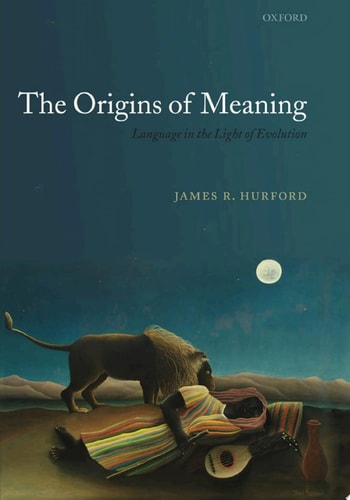
The Origins of Meaning: Language in the Light of Evolution
0
0
As an Amazon Associate and affiliate partner, Menrva Books earns from qualifying purchases. Learn more
Author Description
In this, the first of two ground-breaking volumes on the nature of language in the light of the way it evolved, James Hurford looks at how the world first came to have a meaning in the minds of animals and how in humans this meaning eventually came to be expressed as language. He reviews a mass of evidence to show how close some animals, especially primates and more especially apes, are to the brink of human language. Apes may not talk to us but they construct rich cognitive representations of the world around them, and here, he shows, are the evolutionary seeds of abstract thought - the means of referring to objects, the memory of events, even elements of the propositional thinking philosophers have hitherto reserved for humans. What then, he asks, is the evolutionary path between the non-speaking minds of apes and our own speaking minds? Why don't apes communicate the richness of their thoughts to each other? Why do humans alone have a unique disposition to reveal their thoughts in complex detail? Professor Hurford searches a wide range of evidence for the answers to these central questions, including degrees of trust, the role of hormones, the ability to read minds, and the willingness to cooperate. Expressing himself congenially in consistently colloquial language the author builds up a vivid picture of how mind, language, and meaning evolved over millions of years. His book is a landmark contribution to the understanding of linguistic and thinking processes, and the fullest account yet published of the evolution of language and communication. "A wonderful read - lucid, informative, and entertaining, while at the same time never talking down to the reader by sacrificing argumentation for the sake of 'simplicity'. Likely to be heralded as the major publication dealing with language evolution to date. Frederick J. Newmeyer, University of Washington
Menrva's Summary
THE THESIS
This work investigates the evolutionary trajectory from the cognitive representations found in non-human animals to the complex, propositional language unique to the human species. James R. Hurford, a professor specializing in the evolution of language, synthesizes biological, psychological, and linguistic data to construct a framework for how meaning originated in animal minds. He argues that the seeds of abstract thought and reference exist in primates, and he examines the specific evolutionary pressures that prompted humans to externalize these internal representations through complex communication.
THE SCOPE MAP
What You Will Find
- Comparative analysis of primate cognitive representations and human linguistic structures
- Examination of biological factors including hormonal influence and social trust
- Discussion of the evolutionary transition from non-verbal thought to propositional language
- Synthesis of behavioral evidence regarding animal memory and object reference
Scope Limits
- Does not provide a comprehensive history of specific human languages
- Does not focus on the neurological mechanics of speech production in modern humans
THE AUTHORITY PERSPECTIVE
Experts and academics recognize this text as a foundational contribution to the study of language evolution, noting its ability to bridge the gap between animal cognition and human linguistics. Readers frequently highlight the accessible, colloquial prose style that manages to maintain rigorous argumentation throughout the volume.
Page Count:
404
Publication Date:
2007-01-01
Publisher:
OUP Oxford
ISBN-10:
0191607231
ISBN-13:
9780191607233
Evolutionary Biology
English
Linguistics
Evolutionary Psychology
Anthropology
English & College Success
Community Tags
Other Editions(2)
Similar Books





Reader Comments
Share Your Thoughts
No comments yet. Be the first to share your thoughts!