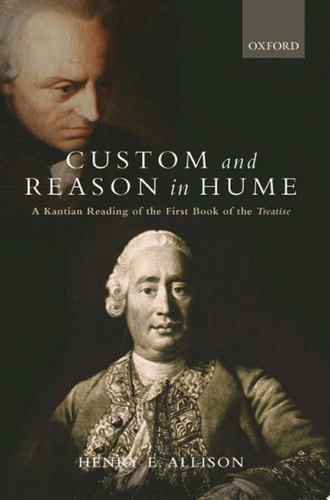
Custom and Reason in Hume: A Kantian Reading of the First Book of the Treatise
0
0
As an Amazon Associate and affiliate partner, Menrva Books earns from qualifying purchases. Learn more
Author Description
Henry Allison examines the central tenets of Hume's epistemology and cognitive psychology, as contained in the Treatise of Human Nature. Allison takes a distinctive two-level approach. On the one hand, he considers Hume's thought in its own terms and historical context. So considered, Hume is viewed as a naturalist, whose project in the first three parts of the first book of the Treatise is to provide an account of the operation of the understanding in which reason is subordinated to custom and other non-rational propensities. Scepticism arises in the fourth part as a form of metascepticism, directed not against first-order beliefs, but against philosophical attempts to ground these beliefs in the "space of reasons." On the other hand, Allison provides a critique of these tenets from a Kantian perspective. This involves a comparison of the two thinkers on a range of issues, including space and time, causation, existence, induction, and the self. In each case, the issue is seen to turn on a contrast between their underlying models of cognition. Hume is committed to a version of the perceptual model, according to which the paradigm of knowledge is a seeing with the "mind's eye" of the relation between mental contents. By contrast, Kant appeals to a discursive model in which the fundamental cognitive act is judgment, understood as the application of concepts to sensory data, Whereas regarded from the first point of view, Hume's account is deemed a major philosophical achievement, seen from the second it suffers from a failure to develop an adequate account of concepts and judgment.
Menrva's Summary
THE THESIS
This work investigates the core tenets of David Hume's epistemology and cognitive psychology in the first book of A Treatise of Human Nature by contrasting his naturalist framework with a Kantian discursive model. Henry E. Allison, a prominent scholar of German idealism, utilizes a two-level analytical approach to evaluate Hume's project. He first situates Hume within his historical context as a naturalist who subordinates reason to custom, then subjects these findings to a rigorous critique based on Immanuel Kant's theory of judgment and conceptual application.
THE SCOPE MAP
What You Will Find
- A detailed examination of Hume's account of the understanding and the role of non-rational propensities.
- A comparative analysis of Hume and Kant on topics including causation, induction, space, time, and the self.
- An exploration of the distinction between Hume's perceptual model of knowledge and Kant's discursive model.
Scope Limits
- The analysis is primarily restricted to the first book of Hume's Treatise of Human Nature.
- The text does not provide a comprehensive overview of Hume's moral or political philosophy.
THE AUTHORITY PERSPECTIVE
Scholars recognize this text as a significant contribution to the comparative study of Enlightenment philosophy, particularly for its precise articulation of the differences between Humean naturalism and Kantian transcendental idealism. Readers frequently note the academic density of the prose, which is intended for advanced students and professional philosophers familiar with both thinkers.
Page Count:
436
Publication Date:
2010-01-01
Publisher:
OUP Oxford
ISBN-10:
0191615528
ISBN-13:
9780191615528
Philosophy
Cognitive Psychology
Kant
Epistemology
Philosophy history
Knowledge Theory
Criticism history
Hume
Community Tags
Similar Books