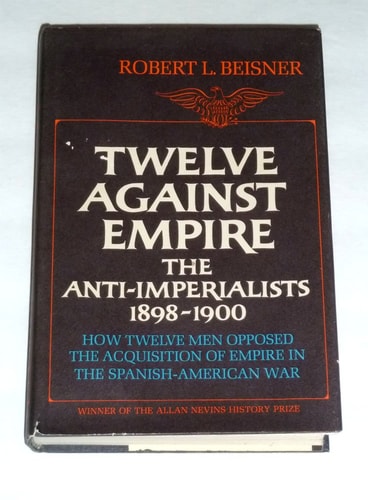
Twelve Against Empire: The Anti-Imperialists, 1898-1900
0
0
As an Amazon Associate and affiliate partner, Menrva Books earns from qualifying purchases. Learn more
Author Description
At a time when domestic opposition to U.S. policy in Asia has reached unprecedented levels, this prize-winning book examines the anti-imperialist protest of twelve prominent and strong-minded Americans against the empire seized from Spain in 1898.Although they did not agree among themselves on all points, these men—whether philosopher (William James), Robber Baron (Andrew Carnegie), ex-President (Benjamin Harrison), perennial dissenter (Carl Schurtz), Speaker of the House (Thomas B. Reed), or closet critic (Charles Eliot Norton)—joined forces with the others in this study and thousands of their countrymen "to warn a nation of optimists that America could not escape the consequences of its own conduct." Their unheeded warning is eloquently renewed in this book.
Menrva's Summary
THE THESIS
This book investigates the ideological motivations and political strategies of twelve prominent Americans who opposed the expansionist foreign policy of the United States following the Spanish-American War. Robert L. Beisner, a historian specializing in American foreign relations, utilizes archival correspondence, public speeches, and contemporary political records to reconstruct the anti-imperialist movement of 1898-1900. He argues that these figures, despite their disparate backgrounds, shared a common concern regarding the moral and constitutional implications of an American empire. The text examines how these individuals attempted to influence public opinion and government policy during a period of rapid national transition.
THE SCOPE MAP
What You Will Find
- Detailed biographical profiles of twelve key anti-imperialist figures including William James, Andrew Carnegie, and Benjamin Harrison.
- Analysis of the political climate in the United States between 1898 and 1900.
- Examination of the arguments used by the Anti-Imperialist League to challenge the annexation of the Philippines and other territories.
Scope Limits
- The book does not provide an exhaustive history of the entire Anti-Imperialist League membership.
- It does not focus on the military history of the Spanish-American War itself, but rather the political fallout.
THE AUTHORITY PERSPECTIVE
Historians frequently cite this work as a definitive study on the intellectual history of American anti-imperialism at the turn of the century. Readers often note the scholarly rigor and the clarity with which Beisner synthesizes complex political motivations.
Page Count:
310
Publication Date:
1968-01-01
Publisher:
McGraw-Hill Book Company
ISBN-10:
0070043434
ISBN-13:
9780070043435
Biography
History
Europe
United States
Foreign Policy
Community Tags
Similar Books