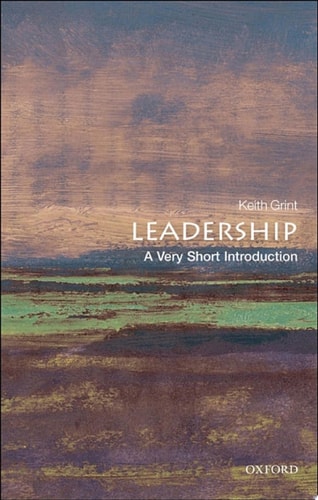
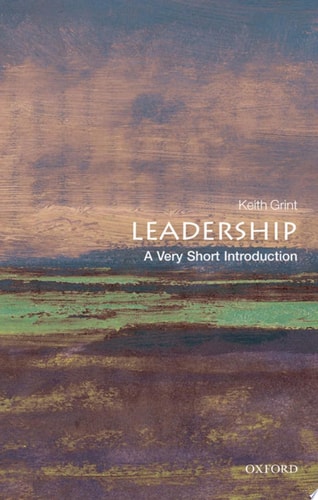
Leadership: A Very Short Introduction
0
0
As an Amazon Associate and affiliate partner, Menrva Books earns from qualifying purchases. Learn more
Author Description
The subject of leadership raises many questions: What is it? How does it differ from management and command? Are leaders born or bred? Who are the leaders? Do we actually need leaders? Inevitably, the answers are provocative and partial; leadership is a hugely important topic of debate. There are constant calls for 'greater' or 'stronger' leadership, but what this actually means, how we can evaluate it, and why it's important are not very clear. In this Very Short Introduction Keith Grint prompts the reader to rethink their understanding of what leadership is. He examines the way leadership has evolved from its earliest manifestations in ancient societies, highlighting the beginnings of leadership writings through Plato, Sun Tzu, Machiavelli and others, to consider the role of the social, economic, and political context undermining particular modes of leadership. Exploring the idea that leaders cannot exist without followers, and recognising that we all have diverse experiences and assumptions of leadership, Grint looks at the practice of management, its history, future, and influence on all aspects of society. ABOUT THE SERIES: The Very Short Introductions series from Oxford University Press contains hundreds of titles in almost every subject area. These pocket-sized books are the perfect way to get ahead in a new subject quickly. Our expert authors combine facts, analysis, perspective, new ideas, and enthusiasm to make interesting and challenging topics highly readable.
Menrva's Summary
THE THESIS
This book investigates the fundamental nature of leadership, questioning whether it is an innate trait or a learned behavior while distinguishing it from management and command. Professor Keith Grint, a recognized expert in public leadership and management studies, utilizes historical analysis and social theory to challenge conventional assumptions. He argues that leadership is a context-dependent phenomenon that cannot be separated from the role of followers and the broader socio-political environment.
THE SCOPE MAP
What You Will Find
- Historical evolution of leadership concepts from ancient societies to the modern era.
- Comparative analysis of leadership, management, and command.
- Philosophical perspectives from thinkers such as Plato, Sun Tzu, and Machiavelli.
- Examination of the symbiotic relationship between leaders and followers.
Scope Limits
- The text does not provide a prescriptive 'how-to' manual for aspiring leaders.
- It does not offer a singular, definitive theory of leadership, focusing instead on the complexity of the subject.
THE AUTHORITY PERSPECTIVE
Experts and readers frequently highlight this text as a concise, intellectually rigorous introduction to the complexities of leadership theory. It is widely regarded as a foundational resource for students and professionals seeking to understand the historical and social dimensions of the field.
Page Count:
161
Publication Date:
2010-01-01
Publisher:
OUP Oxford
ISBN-10:
0191614327
ISBN-13:
9780191614323
Business
Non-Fiction
Leadership
Sociology
Management
Community Tags
Other Editions(3)
Similar Books