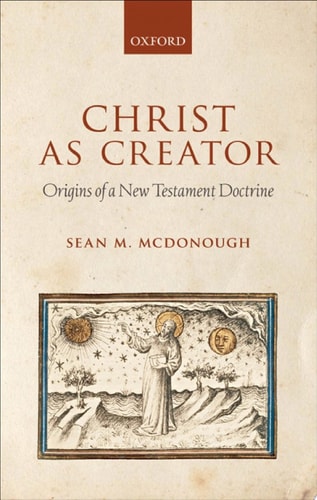
Christ as Creator: Origins of a New Testament Doctrine
0
0
As an Amazon Associate and affiliate partner, Menrva Books earns from qualifying purchases. Learn more
Author Description
This book examines the New Testament teaching that Christ was the one through whom God made the world. While scholars usually interpret this doctrine as arising from the equation of Jesus and the Wisdom of God, Sean McDonough argues that it had its roots in the church's memories of Jesus' miracles. These memories, coupled with the experience of spiritual renewal in the early church, established Jesus as the definitive agent of God's new creation in the New Testament writings and the teachings of the Early Church. Following the logic that 'the end is like the beginning' Christ was taken to be the agent of primal creation. This insight was developed in light of Old Testament creation texts, viewed from within a 'messianic matrix' of interpretation. God gives his Word, his Spirit, and his Wisdom to his Messiah from the very beginning; and the Messiah, the radiance of God's glory, establishes the cosmos in accordance with God's purposes. Creation is the beginning of messianic dominion; he rules the world he made. McDonough carefully substantiates his thesis through a detailed exegesis of the relevant New Testament texts in the context of related texts in Judaism and Greco-Roman philosophy. He concludes with a survey of the doctrine of Christ as Creator in the work of six theologians: Justin Martyr, Irenaeus, Athanasius, Karl Barth, Jürgen Moltmann, and Wolfhart Pannenberg.
Menrva's Summary
THE THESIS
This book investigates the origins of the New Testament doctrine identifying Christ as the agent through whom God created the world. Sean M. McDonough, a scholar of biblical studies, challenges the traditional consensus that this doctrine stems solely from the identification of Jesus with divine Wisdom. Instead, he argues that the belief originated from early church memories of Jesus' miracles and the experience of spiritual renewal, which positioned Jesus as the agent of a new creation. By applying the logic that the end mirrors the beginning, the author demonstrates how early Christians integrated Old Testament creation texts within a messianic framework to establish Christ's role in the cosmos.
THE SCOPE MAP
What You Will Find
- Detailed exegesis of New Testament passages regarding Christ's role in creation
- Analysis of Jewish and Greco-Roman philosophical contexts
- Comparative study of six theologians: Justin Martyr, Irenaeus, Athanasius, Karl Barth, Jürgen Moltmann, and Wolfhart Pannenberg
Scope Limits
- The text does not provide a comprehensive history of all Christological developments in the early church
- It does not focus on liturgical or artistic representations of Christ as Creator
THE AUTHORITY PERSPECTIVE
Scholars and students of theology frequently note the academic rigor and detailed exegetical approach McDonough employs to support his argument. The text is widely recognized as a significant contribution to the study of early Christology and the interpretation of creation theology in the New Testament.
Page Count:
307
Publication Date:
2009-01-01
Publisher:
OUP Oxford
ISBN-10:
0191610348
ISBN-13:
9780191610349
Religion
Christology
Jesus Christ
Creation
Christian Theology
Community Tags
Similar Books