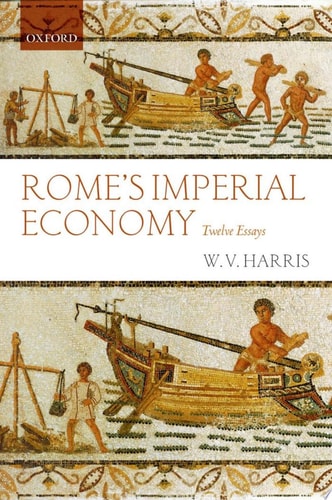
Rome's Imperial Economy: Twelve Essays
0
0
As an Amazon Associate and affiliate partner, Menrva Books earns from qualifying purchases. Learn more
Author Description
Imperial Rome has a name for wealth and luxury, but was the economy of the Roman Empire as a whole a success, by the standards of pre-modern economies? In this volume W. V. Harris brings together eleven previously published papers on this much-argued subject, with additional comments to bring them up to date. A new study of poverty and destitution provides a fresh perspective on the question of the Roman Empire's economic performance, and a substantial introduction ties the collection together. Harris tackles difficult but essential questions, such as how slavery worked, what role the state played, whether the Romans had a sophisticated monetary system, what it was like to be poor, whether they achieved sustained economic growth. He shows that in spite of notably sophisticated economic institutions and the spectacular wealth of a few, the Roman economy remained incorrigibly pre-modern and left a definite segment of the population high and dry.
Menrva's Summary
THE THESIS
This volume investigates whether the Roman Empire achieved economic success and sustained growth by the standards of pre-modern societies. W. V. Harris, a prominent historian of the ancient world, compiles and updates a series of scholarly essays to evaluate the structural limitations of the Roman economy. He argues that despite the existence of sophisticated institutions and concentrated wealth, the system remained fundamentally pre-modern and failed to provide for a significant portion of its population.
THE SCOPE MAP
What You Will Find
- Analysis of Roman monetary systems and state economic intervention
- Examination of the mechanics of slavery and labor productivity
- A dedicated study on the prevalence of poverty and destitution
- A comprehensive introduction synthesizing the collection's arguments
Scope Limits
- The text does not provide a general history of Roman political events
- It does not offer a comprehensive survey of all Roman trade routes or specific provincial economic data
THE AUTHORITY PERSPECTIVE
Scholars and students of classical history frequently cite this collection for its rigorous challenge to optimistic interpretations of Roman economic performance. The prose is noted for its academic density and its focus on the structural constraints that prevented the Roman Empire from achieving modern-style economic growth.
Page Count:
384
Publication Date:
2011-01-01
Publisher:
Oxford University Press
ISBN-10:
0191616494
ISBN-13:
9780191616495
History
Economics
Ancient - Rome
Ancient History
Social History
Community Tags
Similar Books