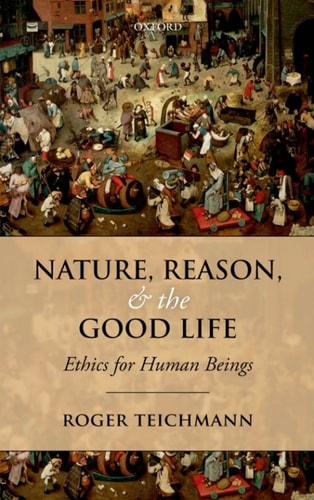
Nature, Reason, and the Good Life: Ethics for Human Beings
0
0
As an Amazon Associate and affiliate partner, Menrva Books earns from qualifying purchases. Learn more
Author Description
At the centre of our ethical thought stands the human being. Facts about human nature determine the shape of ethical concepts in a variety of ways, and our pre-rational animal nature forms the basis of notions to do with rationality, virtue, and happiness, among other things. Nature, Reason, and the Good Life examines these themes while also arguing for the critical importance of language: only by attending to the social and empirical character of actual language use can we make headway with a number of problems in ethics. Thus what counts as a good or bad reason for action depends on the purposes of human enquiry, as embodied in the question 'Why?'--it does not depend, for example, on some abstract and higher Rationality connected with 'the point of the cosmos'. Furthermore, considerations in philosophy of language and in philosophy of mind together show how emotions, desires, and pleasure--all crucial for ethics--turn out not to be inner states carrying a sort of subjective authority, above or below criticism or justification, and this fact helps undermine various forms of subjectivism and individualism to be found both in philosophy and in the wider culture. Starting from an examination of foundational issues, the book covers a range of topics, including animals, agency, enjoyment, the good life, contemplation, death, and the importance of philosophy. En route, there are critiques of a number of prevalent trends of thought, such as utilitarianism, anti-speciesism, relativism, scientism and even 'ism'-ism.
Menrva's Summary
THE THESIS
This work investigates how human nature and the social character of language serve as the foundational elements for understanding ethics, rationality, and the good life. Roger Teichmann, a philosopher specializing in ethics and the philosophy of mind, utilizes a framework that rejects abstract, cosmic rationalism in favor of an empirical, language-centered approach. He argues that ethical concepts are inextricably linked to our pre-rational animal nature and that our understanding of emotions and desires must be grounded in actual social practice rather than subjective inner states.
THE SCOPE MAP
What You Will Find
- An analysis of the relationship between human nature and ethical concepts.
- A critique of subjectivism, individualism, utilitarianism, and anti-speciesism.
- Philosophical arguments regarding agency, enjoyment, contemplation, and death.
Scope Limits
- The text does not provide a comprehensive history of ethical thought.
- It does not offer a prescriptive manual for personal conduct or self-help.
THE AUTHORITY PERSPECTIVE
Scholars and students of philosophy often note the rigorous, analytical nature of Teichmann's prose as he challenges contemporary trends in ethical theory. The book is frequently cited as a dense, specialized contribution to the intersection of language philosophy and moral inquiry.
Page Count:
224
Publication Date:
2011-01-01
Publisher:
Oxford University Press
ISBN-10:
0191619256
ISBN-13:
9780191619250
Philosophy
Philosophy of
Ethics
Human Nature
Community Tags
Similar Books