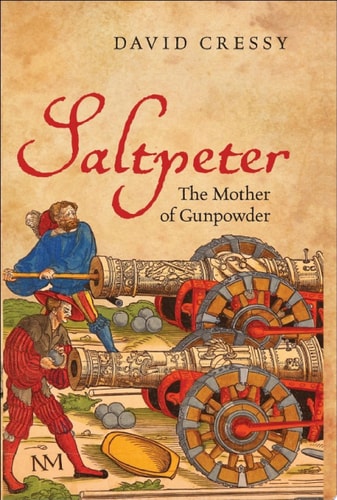
Saltpeter: The Mother of Gunpowder
0
0
As an Amazon Associate and affiliate partner, Menrva Books earns from qualifying purchases. Learn more
Author Description
This is the story of saltpeter, the vital but mysterious substance craved by governments from the Tudors to the Victorians as an 'inestimable treasure.' National security depended on control of this organic material - that had both mystical and mineral properties. Derived from soil enriched with dung and urine, it provided the heart or 'mother' of gunpowder, without which no musket or cannon could be fired. Its acquisition involved alchemical knowledge, exotic technology, intrusions into people's lives, and eventual dominance of the world's oceans. The quest for saltpeter caused widespread 'vexation' in Tudor and Stuart England, as crown agents dug in homes and barns and even churches. Governments hungry for it purchased supplies from overseas merchants, transferred skills from foreign experts, and extended patronage to ingenious schemers, while the hated 'saltpetermen' intruded on private ground. Eventually, huge saltpeter imports from India relieved this social pressure, and by the eighteenth century positioned Britain as a global imperial power; the governments of revolutionary America and ancien régime France, on the other hand, were forced to find alternative sources of this treasured substance. In the end, it was only with the development of chemical explosives in the late Victorian period that dependency on saltpeter finally declined. Saltpeter, the Mother of Gunpowder tells this fascinating story for the first time. Lively and entertaining in its own right, it is also a tale with far-reaching implications. As David Cressy's engaging narrative makes clear, the story of saltpeter is vital not only in explaining the inter-connected military, scientific, and political 'revolutions' of the seventeenth century; it also played a key role in the formation of the centralized British nation state - and that state's subsequent dominance of the waves in the eighteenth and nineteenth centuries.
Menrva's Summary
THE THESIS
This book investigates the critical role of saltpeter in the development of early modern military power, state formation, and global imperial expansion. David Cressy, a historian specializing in early modern England, utilizes archival records and administrative history to argue that the demand for this essential gunpowder ingredient drove significant political, social, and technological shifts. He demonstrates how the state's obsession with securing this resource necessitated the expansion of government reach into private life and influenced international trade policies.
THE SCOPE MAP
What You Will Find
- The history of saltpeter production from the Tudor period through the Victorian era.
- Analysis of the social impact of 'saltpetermen' and state-sanctioned property intrusion.
- Examination of the transition from domestic production to reliance on Indian imports.
- The geopolitical consequences of saltpeter scarcity for Britain, France, and revolutionary America.
Scope Limits
- The book does not provide a technical manual for the chemical synthesis of saltpeter.
- It does not cover the history of gunpowder beyond its reliance on this specific ingredient.
THE AUTHORITY PERSPECTIVE
Historians and reviewers frequently note the book's success in connecting mundane material history to broader themes of state centralization and imperial power. Experts highlight this as a well-researched contribution to the history of technology and early modern governance.
Page Count:
249
Publication Date:
2013-01-01
Publisher:
OUP Oxford
ISBN-10:
0191611867
ISBN-13:
9780191611865
History
Nitrates
Science History
Technology
British History
Political History
Military History
Community Tags
Other Editions(3)

Similar Books











Reader Comments
Share Your Thoughts
No comments yet. Be the first to share your thoughts!