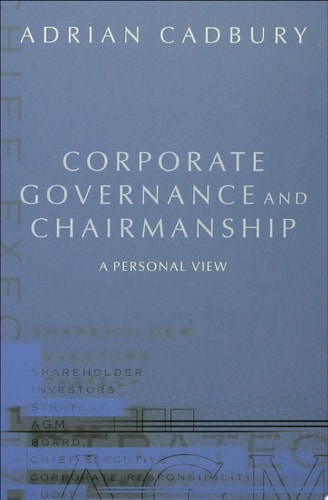
Corporate Governance and Chairmanship: A Personal View
0
0
As an Amazon Associate and affiliate partner, Menrva Books earns from qualifying purchases. Learn more
Author Description
Corporate governance has become a major issue in business over the last decade. Adrian Cadbury has played a central role in developing policies, good practice, and our understanding of the complex issues involved. In 1992 he chaired the committee, sponsored by the Bank of England, whose Report on the Financial Aspects of Corporate Governance (commonly known as the 'Cadbury Report') put issues of corporate governance on the map. Ten years on, Cadbury now reflects on issues of corporate governance and chairmanship drawing on his own business and policy-making experience. In the book, he discusses and explains the central issuse of corporate governance; provides practical advice to chairmen and directors on their roles and responsibilities; and surveys the major codes of practice that have been developed in the last decade. He also considers the implications of the current review of company law and speculates on the implications of electronic developments for shareholders' voice and voting, the extent of a company's social responsibility, and the changing relationship between boards, managers, and investors. This book is both an informed commentary and a practical guide. Cadbury's insights will prove essential reading for anybody taking on senior roles in companies and other public organizations, and will provide well-grounded analysis for management academics, students, and advisers.
Menrva's Summary
THE THESIS
How can the principles of effective corporate governance and the role of the chairman be adapted to meet the evolving demands of modern business and accountability? Adrian Cadbury, a central figure in the development of global governance standards, draws upon his extensive experience chairing the committee responsible for the seminal 1992 Cadbury Report. He utilizes his background in policy-making and corporate leadership to provide a framework for understanding the responsibilities of boards, managers, and investors in a changing economic landscape.
THE SCOPE MAP
What You Will Find
- Analysis of the evolution of corporate governance codes over the decade following the 1992 report.
- Practical guidance for chairmen and directors regarding their specific roles and fiduciary duties.
- Examination of the impact of electronic developments on shareholder engagement and voting mechanisms.
- Discussion on the scope of corporate social responsibility and board-investor relationships.
Scope Limits
- The text focuses primarily on the UK regulatory environment and the specific historical context of the post-1992 governance landscape.
- It does not provide a comprehensive global legal analysis of company law across all jurisdictions.
THE AUTHORITY PERSPECTIVE
Experts and practitioners view this work as a foundational text for understanding the origins of modern corporate governance standards. Readers frequently note the clarity of the author's perspective, which bridges the gap between high-level policy theory and the practical realities of boardroom management.
Page Count:
292
Publication Date:
2002-01-01
Publisher:
OUP Oxford
ISBN-10:
0191611344
ISBN-13:
9780191611346
Business
Professional Development
Finance
Corporate governance
Leadership
Directors of corporations
Management
Principles of Management