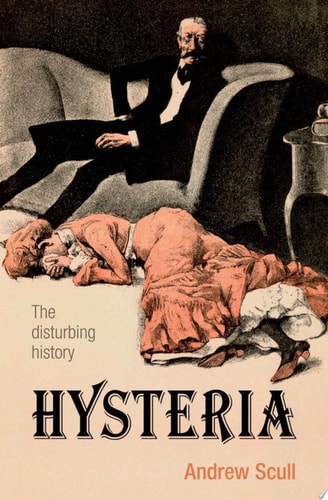
Hysteria: The Disturbing History
0
0
As an Amazon Associate and affiliate partner, Menrva Books earns from qualifying purchases. Learn more
Author Description
The nineteenth century seems to have been full of hysterical women - or so they were diagnosed. Where are they now? The very disease no longer exists. In this fascinating account, Andrew Scull tells the story of Hysteria - an illness that disappeared not through medical endeavour, but through growing understanding and cultural change. More generally, it raises the question of how diseases are framed, and how conceptions of a disease change through history. The lurid history of hysteria makes fascinating reading. Charcot's clinics showed off flamboyantly 'hysterical' patients taking on sexualized poses, and among the visiting professionals was one Sigmund Freud. Scull discusses the origins of the idea of hysteria, the development of a neurological approach by John Sydenham and others, hysteria as a fashionable condition, and its growth from the 17th century. Some regarded it as a peculiarly English malady, 'the natural concomitant of England's greater civilization and refinement'. Women were the majority of patients, and the illness became associated with female biology, resulting in some gruesome 'treatments'. Charcot and Freud were key practitioners defining the nature of the illness. But curiously, the illness seemed to swap gender during the First World War when male hysterics frequently suffering from shell shock were also subjected to brutal 'treatments'. Subsequently, the 'disease' declined and eventually disappeared, at least in professional circles, though attenuated elements remain, reclassified for instance as post-traumatic stress disorder. Hysteria: the biography is part of the Oxford series, Biographies of Diseases, edited by William and Helen Bynum. In each individual volume an expert historian or clinician tells the story of a particular disease or condition throughout history - not only in terms of growing medical understanding of its nature and cure, but also shifting social and cultural attitudes, and changes in the meaning of the name of the disease.
Menrva's Summary
THE THESIS
How did a pervasive medical diagnosis that defined the nineteenth-century female experience vanish from professional clinical practice? Andrew Scull, a professor of sociology and science studies, examines the historical construction of hysteria as a diagnostic category. By synthesizing medical records, cultural artifacts, and the evolution of psychiatric theory, Scull argues that hysteria was less a biological reality and more a reflection of shifting social anxieties and gendered power dynamics.
THE SCOPE MAP
What You Will Find
- The evolution of hysteria from the 17th century through its decline in the 20th century.
- Analysis of the influence of key figures such as Jean-Martin Charcot and Sigmund Freud.
- Examination of the transition from female-coded hysteria to male shell shock during World War I.
Scope Limits
- The text does not provide a clinical manual for modern diagnosis or treatment of related conditions.
- It focuses primarily on Western medical history rather than a global survey of psychiatric practices.
THE AUTHORITY PERSPECTIVE
Experts recognize this work as a significant contribution to the history of medicine, particularly for its critical analysis of how social norms dictate medical classification. Readers frequently note the accessible yet scholarly tone that makes complex historical shifts understandable for both academic and general audiences.
Page Count:
227
Publication Date:
2009-01-01
Publisher:
OUP Oxford
ISBN-10:
0191623334
ISBN-13:
9780191623332
History
Psychology
Non-Fiction
Womens Studies
Sociology
Medicine
Hysteria
Allied Health
Medical
Community Tags
Similar Books