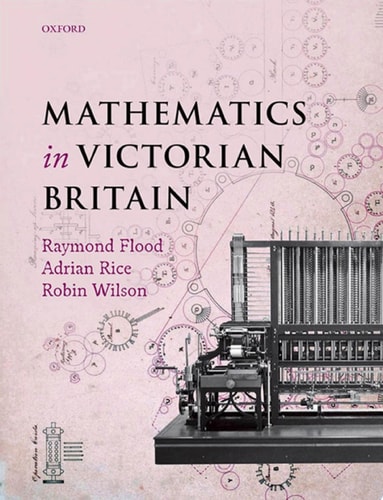
Mathematics in Victorian Britain
0
0
As an Amazon Associate and affiliate partner, Menrva Books earns from qualifying purchases. Learn more
Author Description
During the Victorian era, industrial and economic growth led to a phenomenal rise in productivity and invention. That spirit of creativity and ingenuity was reflected in the massive expansion in scope and complexity of many scientific disciplines during this time, with subjects evolving rapidly and the creation of many new disciplines. The subject of mathematics was no exception and many of the advances made by mathematicians during the Victorian period are still familiar today; matrices, vectors, Boolean algebra, histograms, and standard deviation were just some of the innovations pioneered by these mathematicians. This book constitutes perhaps the first general survey of the mathematics of the Victorian period. It assembles in a single source research on the history of Victorian mathematics that would otherwise be out of the reach of the general reader. It charts the growth and institutional development of mathematics as a profession through the course of the 19th century in England, Scotland, Ireland, and across the British Empire. It then focuses on developments in specific mathematical areas, with chapters ranging from developments in pure mathematical topics (such as geometry, algebra, and logic) to Victorian work in the applied side of the subject (including statistics, calculating machines, and astronomy). Along the way, we encounter a host of mathematical scholars, some very well known (such as Charles Babbage, James Clerk Maxwell, Florence Nightingale, and Lewis Carroll), others largely forgotten, but who all contributed to the development of Victorian mathematics.
Menrva's Summary
THE THESIS
This book investigates the rapid evolution and institutionalization of mathematics in Britain during the 19th century, examining how industrial growth fueled mathematical innovation. The text serves as a comprehensive survey, synthesizing disparate historical research to illustrate how Victorian mathematicians established foundational concepts that remain relevant in modern scientific disciplines. By documenting the transition of mathematics into a formal profession, the author provides a structured overview of both pure and applied mathematical advancements across the British Empire.
THE SCOPE MAP
What You Will Find
- Historical analysis of mathematical professionalization in 19th-century Britain.
- Examination of pure mathematical fields including geometry, algebra, and logic.
- Overview of applied mathematics in statistics, astronomy, and early computing.
- Biographical sketches of prominent figures like Charles Babbage and Florence Nightingale.
Scope Limits
- The text focuses primarily on the British Empire, excluding a global comparative analysis of mathematics during the same period.
- It does not provide deep technical proofs for the mathematical theories discussed, focusing instead on historical context and development.
THE AUTHORITY PERSPECTIVE
Experts recognize this work as a valuable, accessible survey that bridges the gap between specialized academic research and the general reader. Readers frequently note that the book successfully contextualizes complex mathematical history within the broader social and industrial framework of the Victorian era.
Page Count:
475
Publication Date:
2011-01-01
Publisher:
OUP Oxford
ISBN-10:
0191627941
ISBN-13:
9780191627941
Non-Fiction
History
Mathematics
Mathematics Statistics
Victorian Era
Mathematics - General
Science History
Community Tags
Similar Books