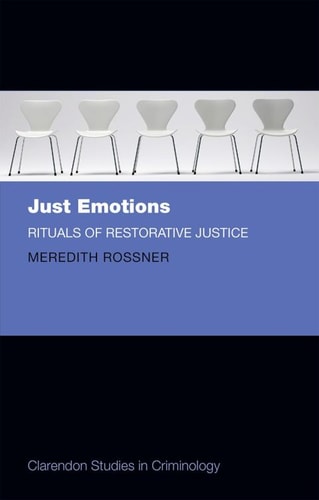
Just Emotions: Rituals of Restorative Justice
0
0
As an Amazon Associate and affiliate partner, Menrva Books earns from qualifying purchases. Learn more
Author Description
Even as restorative justice has captured the attention of justice practitioners, academics and communities worldwide and most research suggests that it has the potential to repair the harm of a criminal offense and reduce offending, there is also evidence that it can have no effect or even make things worse. Just Emotions: Rituals of Restorative Justice attempts to address these conflicting findings by analyzing how conferences work as a unique form of justice ritual. With a pioneering new approach to the micro-level study of the processes and emotions involved in successful conferences, this book offers clues on how to improve the practice and increase successful outcomes. Using an eclectic methodological approach, the author presents a model that adapts Goffman's and Collins' ideas about the interaction ritual chain by focusing on participants' emotions, emotional turning points, and the emergence of rhythm and solidarity between participants. The approach involves a contrasting systematic empirical program, including a combination of qualitative interviews, detailed observations of discourse, face and demeanour, and quantitative analysis of systematically observed conferences, in order to improve the capacity of facilitators and practitioners to produce successful outcomes. Offering an exploration of how rituals unfold dynamically in space and time, alongside analysis of both failed and successful rituals, Just Emotions provides a model of the ritual elements of restorative justice and how these rituals may impact reoffending.
Menrva's Summary
THE THESIS
This book investigates why restorative justice outcomes vary significantly by analyzing the micro-level emotional rituals that occur during justice conferences. Meredith Rossner, a scholar in criminology, utilizes a sociological framework to examine how the interaction between participants influences the success or failure of restorative processes. By applying theories of interaction ritual chains to criminal justice settings, the author argues that the emotional dynamics and solidarity formed during these meetings are the primary drivers of whether a conference effectively repairs harm or fails to do so.
THE SCOPE MAP
What You Will Find
- A theoretical model adapting Goffman and Collins' interaction ritual chains to restorative justice.
- A multi-methodological approach combining qualitative interviews and discourse analysis with quantitative observational data.
- Detailed analysis of emotional turning points and the development of rhythm and solidarity among participants.
Scope Limits
- The study focuses primarily on the micro-level interactions within specific conference settings rather than broader systemic or legislative policy issues.
- It does not provide a comprehensive history of the restorative justice movement.
THE AUTHORITY PERSPECTIVE
Experts in criminology and sociology recognize this work as a significant contribution to the micro-sociological study of justice processes. Readers frequently note the academic density of the prose, which is intended for researchers and practitioners seeking a rigorous analytical framework for understanding restorative outcomes.
Page Count:
200
Publication Date:
2013-01-01
Publisher:
OUP Oxford
ISBN-10:
0191630586
ISBN-13:
9780191630583
Criminology
Social Science
Conflict Resolution
Sociology
Restorative Justice
Law
Community Tags
Similar Books