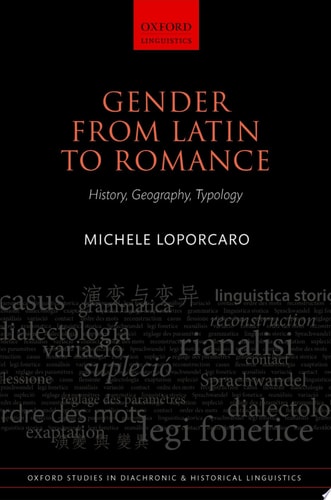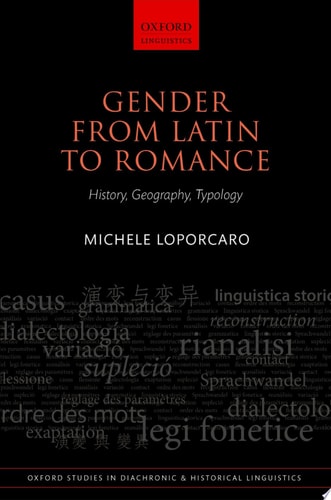
Gender from Latin to Romance: History, Geography, Typology
0
0
As an Amazon Associate and affiliate partner, Menrva Books earns from qualifying purchases. Learn more
Author Description
This book explores grammatical gender in the Romance languages and dialects and its evolution from Latin. Michele Loporcaro investigates the significant diversity found in the Romance varieties in this regard; he draws on data from the Middle Ages to the present from all the Romance languages and dialects, discussing examples from Romanian to Portuguese and crucially also focusing on less widely-studied varieties such as Sursilvan, Neapolitan, and Asturian. The investigation first reveals that several varieties display more complex systems than the binary masculine/feminine contrast familiar from modern French or Italian. Moreover, it emerges that traditional accounts, whereby neuter gender was lost in the spoken Latin of the late Empire, cannot be correct: instead, the neuter gender underwent a range of different transformations from Late Latin onwards, which are responsible for the different systems that can be observed today across the Romance languages. The volume provides a detailed description of many of these systems, which in turns reveals a wealth of fascinating data, such as varieties where 'husbands' are feminine and others where 'wives' are masculine; dialects in which nouns overtly mark gender, but only in certain syntactic contexts; and one Romance variety (Asturian) in which it appears that grammatical gender has split into two concurrent systems. The volume will appeal to linguists from a range of backgrounds, including Romance linguistics, historical linguistics, typology, and morphosyntax, and is also of relevance to those working in sociology, gender studies, and psychology.
Menrva's Summary
THE THESIS
This book investigates the evolution of grammatical gender systems from Latin into the diverse array of modern Romance languages and dialects. Michele Loporcaro, a specialist in Romance linguistics, utilizes a vast dataset spanning from the Middle Ages to contemporary speech to challenge traditional theories regarding the loss of the neuter gender. He argues that the neuter did not simply disappear but underwent complex, varied transformations, resulting in the diverse gender systems observed across modern Romance varieties.
THE SCOPE MAP
What You Will Find
- Comparative analysis of gender systems across Romanian, Portuguese, Sursilvan, Neapolitan, and Asturian.
- Examination of non-binary gender systems that deviate from standard French or Italian models.
- Evidence of syntactic contexts influencing gender marking and concurrent gender systems.
Scope Limits
- The text focuses primarily on grammatical gender evolution and does not provide a comprehensive history of all Romance morphological features.
THE AUTHORITY PERSPECTIVE
Linguists regard this volume as a rigorous contribution to the study of Romance morphosyntax and historical typology. Readers frequently note the academic density of the prose, which is intended for scholars and advanced students of linguistics.
Page Count:
368
Publication Date:
2017-01-01
Publisher:
OUP Oxford
ISBN-10:
0191630519
ISBN-13:
9780191630514
English
Linguistics
Morphosyntax
English & College Success
Historical linguistics
Typology
Grammar