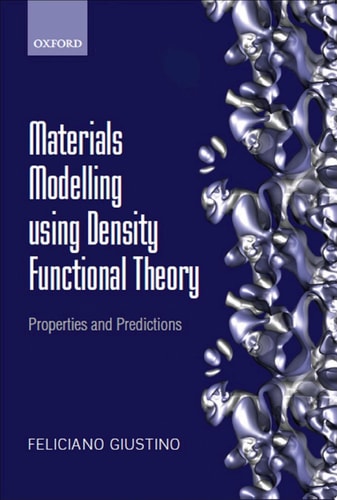
Materials Modelling using Density Functional Theory: Properties and Predictions
0
0
As an Amazon Associate and affiliate partner, Menrva Books earns from qualifying purchases. Learn more
Author Description
This book is an introduction to the quantum theory of materials and first-principles computational materials modelling. It explains how to use density functional theory as a practical tool for calculating the properties of materials without using any empirical parameters. The structural, mechanical, optical, electrical, and magnetic properties of materials are described within a single unified conceptual framework, rooted in the Schrödinger equation of quantum mechanics, and powered by density functional theory. This book is intended for senior undergraduate and first-year graduate students in materials science, physics, chemistry, and engineering who are approaching for the first time the study of materials at the atomic scale. The inspiring principle of the book is borrowed from one of the slogans of the Perl programming language, 'Easy things should be easy and hard things should be possible'. Following this philosophy, emphasis is placed on the unifying concepts, and on the frequent use of simple heuristic arguments to build on one's own intuition. The presentation style is somewhat cross disciplinary; an attempt is made to seamlessly combine materials science, quantum mechanics, electrodynamics, and numerical analysis, without using a compartmentalized approach. Each chapter is accompanied by an extensive set of references to the original scientific literature and by exercises where all key steps and final results are indicated in order to facilitate learning. This book can be used either as a complement to the quantum theory of materials, or as a primer in modern techniques of computational materials modelling using density functional theory.
Menrva's Summary
THE THESIS
How can density functional theory be applied as a practical, non-empirical tool to predict the structural, mechanical, and electronic properties of materials? Feliciano Giustino provides a comprehensive introduction to the quantum theory of materials, specifically designed for senior undergraduate and graduate students in physics, chemistry, and engineering. The text utilizes a unified conceptual framework rooted in the Schrödinger equation, emphasizing heuristic arguments to bridge the gap between abstract quantum mechanics and applied computational modeling.
THE SCOPE MAP
What You Will Find
- Theoretical foundations of density functional theory (DFT)
- Methods for calculating structural, mechanical, optical, electrical, and magnetic properties
- Cross-disciplinary integration of materials science, electrodynamics, and numerical analysis
- Pedagogical exercises with indicated key steps and results
Scope Limits
- Advanced, highly specialized research topics beyond the scope of a primer
- Purely experimental laboratory techniques
THE AUTHORITY PERSPECTIVE
Experts and educators recognize this text as a highly accessible entry point for students transitioning into computational materials science. Readers frequently note the balance between theoretical rigor and the practical, intuitive approach to complex quantum mechanical calculations.
Page Count:
306
Publication Date:
2014-01-01
Publisher:
OUP Oxford
ISBN-10:
0191639435
ISBN-13:
9780191639432
Science
Materials
Earth Sciences
Functional analysis
Chemistry
Physics
Mathematical Physics
Community Tags
Other Editions(2)
Similar Books