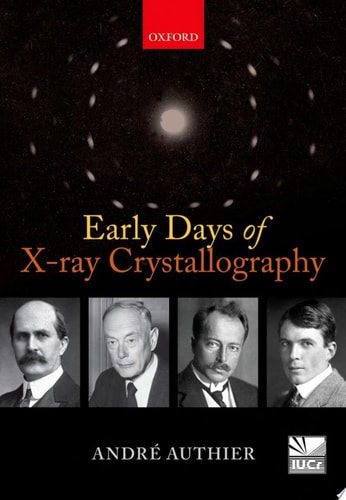
Early Days of X-ray Crystallography
0
0
As an Amazon Associate and affiliate partner, Menrva Books earns from qualifying purchases. Learn more
Author Description
The Year 2012 Marked The Centenary Of One Of The Most Significant Discoveries Of The Early Twentieth Century, The Discovery Of X-ray Diffraction (march 1912, By Laue, Friedrich And Knipping) And Of Bragg's Law (november 1912). The Discovery Of X-ray Diffraction Confirmed The Wave Nature Of X-rays And The Space-lattice Hypothesis. It Had Two Major Consequences: The Analysis Of The Structure Of Atoms, And The Determination Of The Atomic Structure Of Materials. This Had A Momentous Impact In Chemistry, Physics, Mineralogy, Material Science, Biology And X-ray Spectroscopy. The Book Relates The Discovery Itself, The Early Days Of X-ray Crystallography, And The Way The News Of The Discovery Spread Round The World. It Explains How The First Crystal Structures Were Determined By William Bragg And His Son Lawrence, And Recounts Which Were The Early Applications Of X-ray Crystallography In Chemistry, Mineralogy, Materials Science, Physics, Biological Sciences And X-ray Spectroscopy. It Also Tells How The Concept Of Space Lattice Developed Since Ancient Times Up To The Nineteenth Century, And How Our Conception Of The Nature Of Light Has Changed Over Time. The Contributions Of The Main Actors Of The Story, Prior To The Discovery, At The Time Of The Discovery And Immediately Afterwards, Are Described Through Their Writings And Are Put Into The Context Of The Time, Accompanied By Brief Biographical Details. This Thoroughly Researched Account On The Multiple Faces Of A Scientific Specialty, X-ray Crystallography, Is Aimed Both At The Scientists, Who Rarely Subject The Historical Material Of Past Discoveries In Their Field To Particular Scrutiny With Regard To The Historical Details And At The Historians Of Science Who Often Lack The Required Expert Knowledge To Scrutinize The Involved Technical Content In Sufficient Depth (m. Eckert - Metascience).
Menrva's Summary
THE THESIS
This book investigates the historical origins and scientific impact of the discovery of X-ray diffraction and Bragg's Law during the centennial year of 1912. Author André Authier, a distinguished physicist, utilizes primary source writings and biographical data to reconstruct the intellectual environment surrounding this breakthrough. The text argues that the discovery of X-ray diffraction was not an isolated event but the culmination of long-standing theories regarding the space-lattice hypothesis and the wave nature of light. By contextualizing the contributions of key figures like Laue, Friedrich, Knipping, and the Braggs, the author provides a rigorous framework for understanding how these findings transformed chemistry, mineralogy, and biology.
THE SCOPE MAP
What You Will Find
- A detailed timeline of the discovery of X-ray diffraction and Bragg's Law.
- Historical analysis of the space-lattice concept from antiquity to the twentieth century.
- Biographical sketches of the primary scientists involved in the early development of the field.
- Technical explanations of how early crystal structures were determined.
Scope Limits
- The book focuses primarily on the early twentieth-century period and does not cover modern advancements in synchrotron radiation or computational crystallography.
THE AUTHORITY PERSPECTIVE
Experts and historians of science frequently highlight this work as a bridge between technical scientific documentation and historical narrative. Readers note the academic density of the prose, which provides the necessary depth for both practicing scientists and historians to appreciate the nuances of the discovery.
Page Count:
456
Publication Date:
2013-01-01
Publisher:
OUP Oxford
ISBN-10:
0191635014
ISBN-13:
9780191635014
Science
Biography
Kindle Store
Solid-State Physics
Science History
Physics
Categories
Kindle eBooks
Chemistry
Community Tags
Other Editions(4)

Similar Books












Reader Comments
Share Your Thoughts
No comments yet. Be the first to share your thoughts!