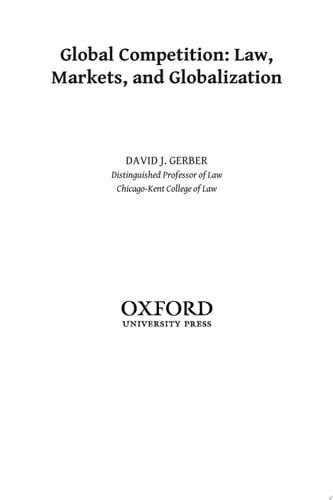
Global Competition: Law, Markets, and Globalization
0
0
As an Amazon Associate and affiliate partner, Menrva Books earns from qualifying purchases. Learn more
Author Description
Global competition now shapes economies and societies in ways unimaginable only a few years ago, and competition (or 'antitrust') law is a key component of the legal framework for global competition. These laws are intended to protect competition from distortion and restraint, and on the national level they reflect the relationships between markets, their participants, and those affected by them. The current legal framework for the global economy is provided, however, by national laws and institutions. This means that those few governments that have sufficient 'power' to apply their laws to conduct outside their own territory provide the norms of global competition. This has long meant that the US (and, more recently, the EU) structure global competition, but China and other countries are increasingly using their economic and political leverage to apply their own competition laws to global markets. The result is increasing uncertainty, costs, and conflicts that burden global economic development. This book examines competition law on the global level and reveals its often complex and little-understood dynamics. It focuses on the interactions between national and international legal regimes that are central to these dynamics and a key to understanding them. Part I examines the evolution of the current global system, the factors that have shaped it, how it operates today, and recent efforts to alter that system-e.g., by including competition law in the WTO. Part II focuses on national competition law systems, revealing how national laws and experiences shape global competition law dynamics and how global factors, in turn, shape national laws and experiences. It examines the central roles of US and European law and experience, and it also pays close attention to countries such as China that are playing increasingly important roles in the global competition law arena. Part III analyzes current strategies for improving the legal framework for global competition and ident
Menrva's Summary
THE THESIS
This book investigates how national competition laws function as the primary, yet often conflicting, regulatory framework for the increasingly integrated global economy. David E. Gerber, a professor of law and expert in international competition systems, utilizes a comparative legal analysis to examine the tensions between domestic antitrust enforcement and the requirements of global markets. He argues that the current reliance on powerful nations like the US, EU, and China to project their domestic laws extraterritorially creates systemic instability and economic friction.
THE SCOPE MAP
What You Will Find
- Historical evolution of global competition law systems.
- Analysis of the intersection between WTO policies and national antitrust frameworks.
- Comparative study of legal regimes in the US, EU, and China.
- Evaluation of strategies for international legal harmonization.
Scope Limits
- Does not provide a comprehensive legal manual for corporate compliance.
- Does not offer a definitive legislative proposal for a unified global antitrust authority.
THE AUTHORITY PERSPECTIVE
Legal scholars and practitioners frequently cite this work for its clear articulation of the complex interplay between national sovereignty and global market regulation. Experts highlight the text as a foundational resource for understanding the geopolitical dimensions of antitrust law in the twenty-first century.
Page Count:
415
Publication Date:
2012-01-01
Publisher:
OUP Oxford
ISBN-10:
0191633623
ISBN-13:
9780191633621
Economics
Globalization
International relations
Law
Antitrust Law
Community Tags
Similar Books